

Research
Acetate vs. TFA Peptide Salts: A Critical Review of Stability and Research Considerations
Abstract
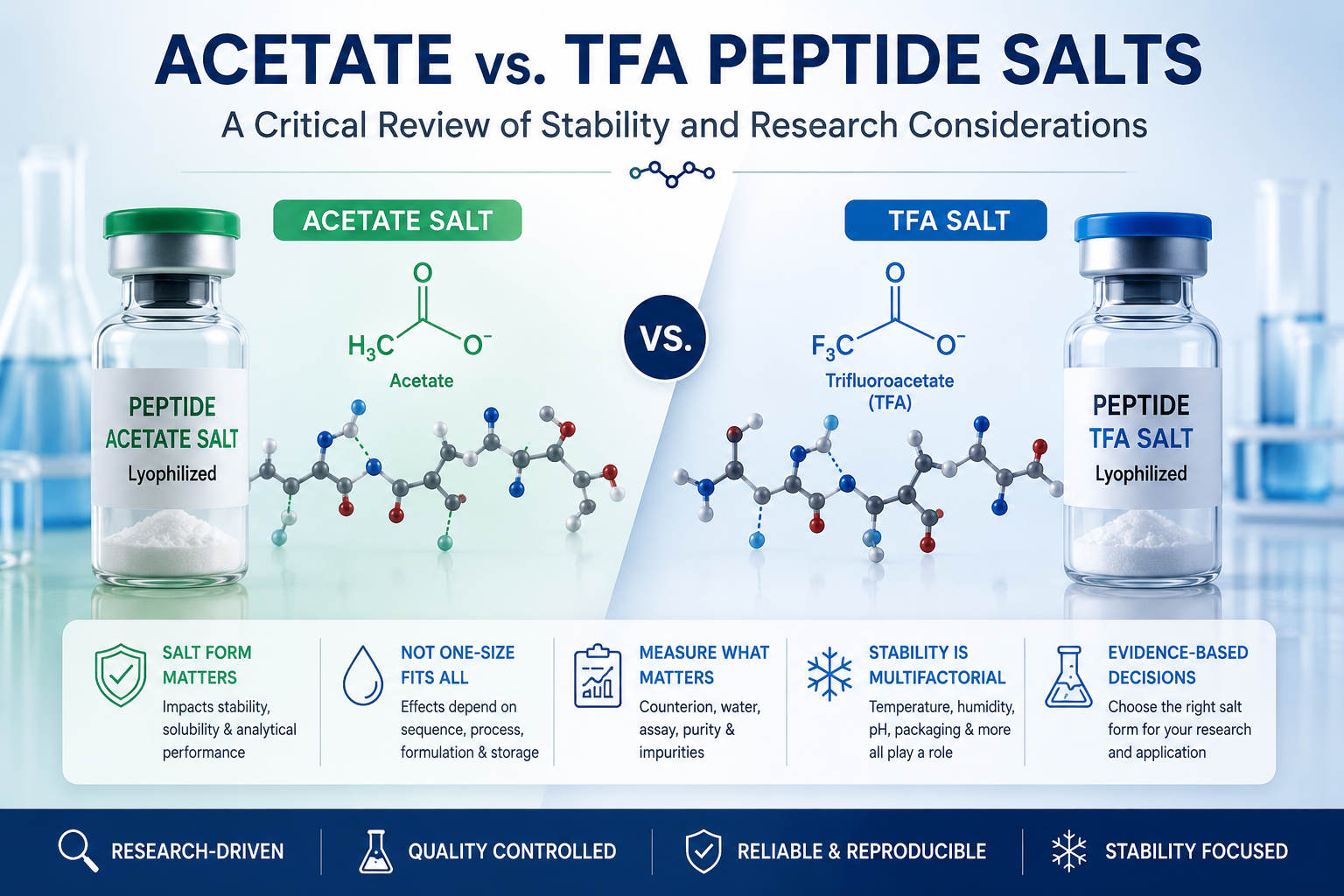
The salt form is an important material characteristic for various synthetic peptides, yet it is neither an isolated nor universally predictive factor for shelf-life. Fundamental peptide sites often link with anionic counterions that are introduced during cleavage, purification, exchange, or formulation. Acetate and trifluoroacetate (TFA) can modify peptide mass balance, reconstitution pH, ionic strength, moisture absorption, solid-state arrangement, solubility, aggregation, analytical response, and functional assay behavior. These effects could affect the observed stability; however, the direction and extent are dependent on sequence, process, formulation, and storage. The general idea that acetate salts are intrinsically more stable than TFA salts is not supported by the available data. While acetate is often used when a nonfluorinated counterion is desired for biological or developmental study, TFA is practically advantageous since it is widely used in solid-phase peptide synthesis and reversed-phase chromatography. Quantitative characterization is required for both kinds. An adequate scientific assessment of peptide salt forms might include counterion stoichiometry, moisture levels, peptide assay, impurity analysis, physical stability, reconstitution properties, and, if applicable, functional assay results under specified real-time and stress conditions. In order to evaluate acetate and TFA peptide salts without inflating the available data, this review looks at the molecular basis, evidential limitations, analytical protections, and useful study design.
1. Introduction
This narrative review explores synthetic peptide drug substances and research-grade lyophilized peptides provided in the form of acetate or trifluoroacetate salts. It incorporates formulation studies, new assessments, peer-reviewed research on counterion exchange and characterization, and regulatory suggestions relevant to synthetic peptides and stability evaluations. The existing literature continues to be diverse, with numerous studies analyzing various peptide sequences, concentrations, buffers, analytical techniques, and biological systems. There are very few studies that provide direct, long-term comparisons of the same peptide in TFA and acetate forms. Therefore, data from particular peptide systems and molecular explanations should not be taken as general evidence of a shelf-life advantage.
The word "shelf-life" is used in a specific context in this analysis. A formal stability program determines the shelf-life of an approved pharmaceutical product. A retest period might be more suitable for a drug substance. For materials used in research, any specified storage duration must also be backed by appropriate stability data rather than assumed based solely on salt form (International Council for Harmonisation [ICH], 2003).
2. Why Peptides Are Commonly Isolated as Salts
The N-terminus and the side chains of lysine, arginine, and histidine are examples of synthetic peptides that have protonatable groups. TFA is widely used in Fmoc solid-phase peptide synthesis for resin cleavage and general deprotection. In reversed-phase high-performance liquid chromatography, TFA is frequently used as an ion-pairing agent. Therefore, unless a process for exchange is used, cationic peptides are usually first obtained as materials coupled with TFA (Roux et al., 2008; Sikora et al., 2020).
The ultimate solid is not necessarily a single perfect stoichiometric salt. It might have fluctuating levels of counterion, residual water, ions from the process, solvents, and additional nonpeptide mass. The occupancy of counterions may be influenced by the quantity and accessibility of protonated sites, the pH of the solution, exchange parameters, washing effectiveness, lyophilization, and the history of storage. Therefore, unless the counterion composition and reporting basis are given, the labels "acetate salt" or "TFA salt" are insufficient.
3. Salt Form as One Part of a Multivariable Stability System
Peptide breakdown is influenced by sequence, structure, temperature, humidity, oxygen, light exposure, pH level, buffer components, trace metals, concentration, interfaces, additives, and packaging. Significant pathways comprise deamidation, isomerization, hydrolysis, oxidation, disulfide exchange, racemization, diketopiperazine formation, aggregation, adsorption, and precipitation. The dominant degrading route is not exclusively determined by a counterion, but it can affect one or more of these characteristics.
Variations between acetate and TFA samples may therefore reflect differences in counterion chemistry, but they may also result from differences in water content, levels of residual solvents, peptide recovery during exchange, differences in amorphous or crystalline properties, or changes brought about by additional processing. These confounders must be taken into consideration in a meaningful comparison.
4. Trifluoroacetate Salts
4.1. Practical advantages
TFA salts are useful in the discovery and early development phases as they can be directly sourced from conventional cleavage and purification processes. For low-yield or milligram-scale peptides, minimizing counterion exchange can reduce material loss and processing time. TFA also facilitates efficient ion pairing in various chromatographic separations, although its role in an analytical mobile phase differs from any residual TFA present in the isolated peptide.
In regulated moisture, oxygen, and temperature environments, certain TFA peptide salts might exhibit satisfactory chemical and physical stability. The stability observed is specific to the peptide, formulation, packaging, and conditions. In some sequences, base-catalyzed processes such as particular asparagine deamidation routes may be slowed down by acidic reconstitution conditions. This represents a potential mechanistic condition, rather than proof that TFA significantly increases shelf-life.
4.2. Limitations and controls
TFA may remain ionically bound to positively charged peptide sequences, and standard exchange techniques may not completely or consistently remove it (Roux et al., 2008; Erckes et al., 2025). As a result, the quantity of TFA kept might differ across batches. Since the measured powder mass consists of both peptide and TFA, calculations relying solely on the overall powder weight may falsely inflate the true peptide content. Quantitative evaluation of counterion levels, water levels, and peptide levels ensures precise mass balance and correct testing of experimental concentrations.
Remaining TFA could also influence solution pH, ionization characteristics, membrane-partition tests, spectroscopic analysis, or certain biological assays. The magnitude and orientation of any biological impact rely on the peptide concentration, counterion concentration, assay matrix, duration of exposure, and endpoint. Therefore, to say that TFA salts are generally unsuitable for cell-based applications would be unduly forceful. A more accurate approach is to measure TFA and, if the assay is sensitive, regulate it with matching counterion controls or compare it to an exchanged salt.
Analytical methods encompass quantitative fluorine-19 nuclear magnetic resonance, ion chromatography, liquid chromatography with appropriate detection, evaporative light-scattering detection, and verified spectroscopic techniques. Since peptide binding and matrix effects might influence perceived recovery, orthogonal confirmation is useful in method development (Erckes et al., 2025; López-Sánchez et al., 2025).
5. Acetate Salts
5.1 Rationale for use
In peptide research and medication development, acetate is frequently used as a nonfluorinated counterion. It may be selected to avoid residual TFA, to align with a recommended formulation, or to reduce a potential confounding factor in biological assessments. Nonetheless, the acceptance by regulators varies by product. Both acetate and TFA cannot be deemed inherently acceptable or unacceptable without evaluating exposure, manufacturing controls, specifications, and the intended administration route.
Acetate salt formation can affect solubility, solid-state characteristics, and reconstitution pH in a manner specific to each peptide. These traits should be determined through experimentation instead of being inferred solely from the identity of the counterion. There is no evidence to support general statements that acetate always produces a cleaner cake, less hygroscopicity, or a longer shelf life across different peptide classes.
5.2 Volatility and process dependence
Acetic acid is volatile, and the retention of acetate during lyophilization relies on the composition of the formulation and the conditions used during processing. Acetate ratios may change during manufacture, as demonstrated by the effects of buffer composition and lyophilization parameters on counterion retention, pH upon reconstitution, and peptide stability in a CSP7 peptide model (Sahakijpijarn et al., 2019). This discovery encourages routine acetate measurement rather than relying on nominal salt classification, although it shouldn't be quantitatively applied to all peptides.
Additional processing steps that may affect peptide recovery, purity, moisture content, leftover solvents, and other material properties are included in counterion exchange. Consequently, an acetate sample generated by exchanging a TFA salt could vary from the original substance in aspects beyond just counterion identity. Prior to evaluating their stability, it is necessary to characterize both samples for peptide identification, purity, assay, water content, counterion content, and significant process-related impurities. This aids in identifying if any noted stability variation is genuinely linked to the salt form or to alterations made during processing.
6. Mechanisms by Which Counterions May Influence Observed Stability
6.1 Reconstitution pH and buffer capacity
The initial pH of an unbuffered or weakly buffered peptide solution might be impacted by counterions. A seemingly salt-form effect may actually be a pH effect because many degradation events depend on pH. Therefore, identical peptide concentrations, diluents, ionic strengths when feasible, containers, and temperatures should be used in matched comparisons. Additionally, pH must be recorded immediately following reconstitution and during storage.
6.2 Residual water and moisture sorption
Residual water can accelerate chemical or physical changes and improve molecular mobility in amorphous substances. Although these effects are particular to the peptide and formulation utilized, the identity and stoichiometry of counterions can affect water absorption, glass-transition properties, crystallinity, or cake structure. The Karl Fischer method for water determination provides more insight than simply presuming that one salt is naturally drier or less hygroscopic.
6.3 Mass balance and assay
The powder mass comprises peptides, counterions, water, residual solvents, and various nonvolatile or volatile substances. An alteration in water or counterion levels can create an apparent shift in peptide percentage without causing chemical degradation. The EMA guideline for synthetic peptides highlights counterion content, water, assay, impurities, and pH-related factors as possibly significant aspects of control (European Medicines Agency [EMA], 2023). Results reported on an as-is, anhydrous, and counterion-free basis must be distinguished in stability reports. Results from different batches or experiments may not be directly comparable without this information.
6.4 Aggregation and self-assembly
Counterions have the ability to influence molecular interactions and counteract electrostatic repulsion. In self-assembling systems, these effects may alter aggregation, fibrillation, gelation, solubility, or drug release. Recent research on a particular long-acting peptide hydrogel platform demonstrated that the salt form influenced certain rheological, biostability, cytotoxicity, and release characteristics (Moore et al., 2025). These results indicate that counterion selection affected material characteristics in that particular experimental setup; they do not provide a general ranking of acetate, TFA, or chloride salts.
6.5 Analytical and bioassay behavior
When added to chromatographic mobile phases, TFA may hinder electrospray ionization; residual counterion in a sample may also alter the composition of the solution. FT-IR can detect specific TFA bands, but quantitative analysis might vary depending on the matrix. Control formulations should have the same counterion concentration as the test formulation for potency or functional tests. Before attributing a biological difference to peptide salt form, consideration should be given to peptide content, pH, osmolality, ionic strength, and counterion exposure.
7. Evidence-Based Comparison of Acetate and TFA
Parameter | Acetate salt | TFA salt |
How it is obtained | Typically generated via salt exchange | Commonly remains after TFA cleavage and RP-HPLC purification |
Main advantage | Avoids a fluorinated counterion and might be more appropriate for certain biological or formulation investigations | Convenient as it might not necessitate an extra salt-exchange process |
Shelf-life | Not automatically more stable; relies on the peptide and formulation | Not automatically less stable; relies on the peptide and formulation |
Counterion behavior | Acetate could be partially lost during processing or Lyophilization | TFA remain strongly bonded to positively charged peptide sites |
Biological studies | Can be chosen when residual TFA is viewed as a possible interference in the assay | May require counterion controls in cell, membrane, immune, or in vivo studies |
Peptide recovery | Exchange can lead to some loss of peptides | Avoids material losses that could happen during an extra counterion-exchange step |
Purity risk | Additional processing could alter purity or cause degradation | Less processing involved, yet residual TFA might still vary |
Potential Research Context | Biological research, formulation development, and advance research aligned with data | Early-stage discovery, purification, analytical tasks, and biological research when TFA is regulated |
Main caution | Do not assume acetate automatically improves stability or biological efficacy | Do not assume residual TFA is negligible or lacks an impact on the assay |
8. Designing a Defensible Salt-Form Stability Comparison
Materials that are as closely aligned as possible should be used to start a direct comparison investigation. The acetate and TFA forms should ideally originate from the same pure peptide pool and be processed in accordance with documented procedures. Rather than being disregarded, the additional exchange and drying procedures should be considered potential sources of change.
At a minimum, record and regulate:
peptide sequence, ends, disulfide condition, and molecular form;
initial identity, chromatographic quality, impurity characterization, and peptide assay;
identity of the counterion and molar or mass ratio;
water content and, where relevant, residual solvents;
fill volume, headspace, packaging system, and light exposure;
temperature for storage and humidity exposure;
reconstitution diluent, concentration, pH level, and container interaction;
performance of the analytical method, including specificity and precision.
8.1 Storage conditions
Stability studies for the long term must assess the suggested storage conditions for the specific material. For materials designated for frozen storage, the study conditions must align with the intended storage specifications instead of automatically applying room-temperature ICH conditions. Conditions like 25 °C/60% relative humidity and 40 °C/75% relative humidity are recognized ICH examples for specific room-temperature drug substances and products; however, they should not be blindly replicated as official conditions for a peptide designated for frozen storage. As long as the scientific goal is explicit and the container's permeability is known, they can be used as stress or excursion conditions (ICH, 2003).
Open-vial humidity tests can evaluate moisture sensitivity but do not independently validate a closed-container shelf life. When a sequence, formulation, or container poses a risk from exposure to light, photostability testing should be considered.
8.2 Reconstituted stability
Solution studies must depict practical conditions including specified diluent, desired concentration, refrigerated storage, exposure at room temperature, risk of adsorption, and intended freeze-thaw methodology. Freeze-thaw experiments should be incorporated only when multiple cycles of freezing and thawing are applicable to the expected experimental procedure. Any suggested usage duration should be backed by data obtained using the appropriate solvent, concentration, container system, temperature, and microbiological environment.
9. Researcher-Facing Selection Framework
A thoroughly characterized TFA salt might be appropriate for noncellular discovery assays. Acetate or chloride may be selected to reduce one potential confounding factor in cell-based, membrane, immunological, or in vivo research, but it should not be considered that the exchange improves the peptide itself. In biological assays, when comparing salt forms, the test concentrations should be adjusted based on the actual peptide content rather than equal total powder mass.
Data must be used to guide the selection of salt for formulation development. A form that provides a good combination of manufacturability, recovery, counterion consistency, solubility, physical state, impurity control, stability and functional performance relevant to the intended experimental formulation. A sequence that has oxidation-prone, deamidation-prone, or acid-labile motifs needs appropriate control, yet these sequence flaws alone do not determine acetate or TFA.
The storage requirements for lyophilized research peptides should rely on specific stability information for each peptide, batch records, packaging traits, and suggestions from the supplier. General assumptions related to temperature, light exposure, moisture sensitivity, solvent selection, or duration after reconstitution should be avoided. Following reconstitution, use an appropriate solvent and concentration, reduce unnecessary handling, and avoid unsupported universal in-use durations.
10. Limitations of the Current Evidence
There is a lack of many direct, long-term, matched comparisons between TFA and acetate forms. A significant portion of the existing literature focuses on counterion exchange efficiency, analytical measurement, biological behavior, or specific delivery systems instead of shelf-life in standard lyophilized vials. Therefore, peptide-specific findings should be cited as examples rather than being categorized broadly. Future research would gain from disclosing counterion molar ratios, water content, solid-state characteristics, peptide assays, impurity kinetics, and corresponding solution conditions across several sequences.
Conclusion
Acetate and TFA can affect reported peptide stability by altering mass balance, pH, water interactions, solid-state behavior, intermolecular associations, and assay parameters. In terms of shelf life, neither counterion has a universal advantage. TFA is prevalent and efficient in operations, yet its residual level needs to be measured and taken into account in analytical and biological research. Although acetate is a frequently used nonfluorinated replacement, the procedure may affect its stoichiometry and retention. An appropriate scientific method involves considering the counterion form as a potentially significant material characteristic, assessing its role in the sample, managing key confounding factors, and determining storage durations based on stability information related to the peptide, formulation, container system, and intended research application.
References
Erckes, V., Streuli, A., Chamera Rendueles, L., Krämer, S. D., & Steuer, C. (2025). Towards a consensus for the analysis and exchange of TFA as a counterion in synthetic peptides and its influence on membrane permeation. Pharmaceuticals, 18(8), 1163. https://doi.org/10.3390/ph18081163
European Medicines Agency. (2023). Guideline on the development and manufacture of synthetic peptides. https://www.ema.europa.eu/en/development-manufacture-synthetic-peptides-scientific-guideline
International Council for Harmonisation of Technical Requirements for Pharmaceuticals for Human Use. (2003). Q1A(R2): Stability testing of new drug substances and products. https://database.ich.org/sites/default/files/Q1A%28R2%29%20Guideline.pdf
López-Sánchez, A. G., Rodríguez-Mejía, K. G., Cuero-Amu, K. J., Ardila-Chantré, N., Rivera-Monroy, Z. J., & García-Castañeda, J. E. (2025). A new methodology for synthetic peptides purification and counterion exchange in one step using solid-phase extraction chromatography. Processes, 13(1), 27. https://doi.org/10.3390/pr13010027
Moore, J. V., Cross, E. R., An, Y., Pentlavalli, S., Coulter, S. M., Sun, H., & Laverty, G. (2025). Impact of counterion and salt form on the properties of long-acting injectable peptide hydrogels for drug delivery. Faraday Discussions, 260, 215–234. https://doi.org/10.1039/D4FD00194J
Roux, S., Zékri, E., Rousseau, B., Paternostre, M., Cintrat, J.-C., & Fay, N. (2008). Elimination and exchange of trifluoroacetate counter-ion from cationic peptides: A critical evaluation of different approaches. Journal of Peptide Science, 14(3), 354–359. https://doi.org/10.1002/psc.951
Sahakijpijarn, S., Moon, C., Koleng, J. J., & Williams, R. O., III. (2019). Formulation composition and process affect counterion for CSP7 peptide. Pharmaceutics, 11(10), 498. https://doi.org/10.3390/pharmaceutics11100498
Sikora, K., Jaśkiewicz, M., Neubauer, D., Migoń, D., & Kamysz, W. (2020). The role of counter-ions in peptides—An overview. Pharmaceuticals, 13(12), 442. https://doi.org/10.3390/ph13120442