
Peptide Science
Bacteriostatic Water in Peptide Research: Composition, Quality, and Compatibility
Introduction
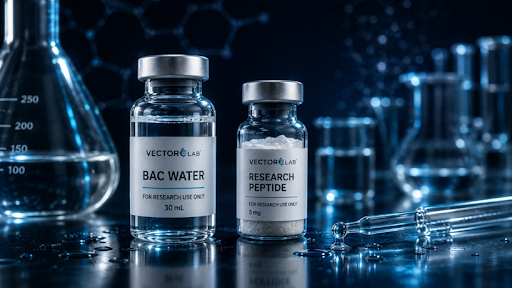
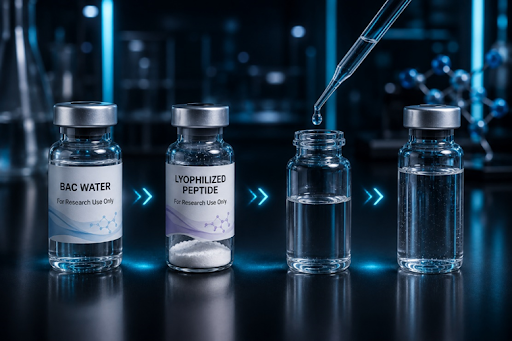
In peptide research, Bacteriostatic water is a specific type of supporting substance utilized in specific laboratory reconstitution procedures. Bacteriostatic water can serve as a diluent in lab procedures that involve compatible lyophilized substances. The water used for reconstitution can affect sample clarity, stability, contamination risk, and research uniformity, even though the peptide usually receives the most attention.
In research applications, BAC water must be assessed with suitable quality documentation and criteria specific to the protocol. The solvent used in peptide research must be pure, documented, compatible, and suitable for the given protocol. This guide outlines the essential factors that researchers must understand prior to utilizing water-based diluents with peptides.
What Is Bacteriostatic Water?
Commercial Bacteriostatic Water for Injection is a regulated sterile product type that includes water for injection and a bacteriostatic preservative, typically benzyl alcohol. Research-quality water products must be characterized by their true composition, analytical standards, labeling, and intended research application. It comes in a multi-dose bottle that allows for several withdrawals to dissolve or dilute appropriate compounds (U.S. National Library of Medicine, 2026).
For products intended solely for research use, documentation serves as the primary indicator of quality. Researchers must determine the composition of the water, look for preservatives, and verify whether batch-level quality testing is carried out.
Sterile Water vs. Bacteriostatic Water
Water without an antibacterial preservative is considered sterile. When opened, it lacks a preservative system to stop microbial growth. It is usually more appropriate for single-use procedures or controlled laboratory methods where sterile handling is maintained.
Bacteriostatic water includes a preservative, typically benzyl alcohol. Bacteriostatic Water for Injection, normally contains 0.9% benzyl alcohol, or 9 mg/mL, according to the U.S. National Library of Medicine; however, other presentations claim 1.1% based on the product label (U.S. National Library of Medicine, 2026). The product is not self-sterilizing due to the preservative. It merely aids in preventing microbial growth post-container entry when utilized as instructed.
Sterile water and bacteriostatic water possess distinct formulation properties and must be assessed independently when creating a laboratory protocol. The selection relies on peptide compatibility, assay configuration, preservative sensitivity, storage needs, and protocol requirements.
Why Benzyl Alcohol Matters?
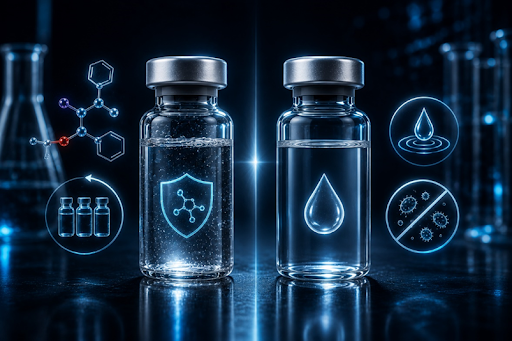
Benzyl alcohol serves as a bacteriostatic preservative, though it has formulation-specific restrictions. In research applications, its existence should be acknowledged since preservatives can influence specific cell-based assays, peptide systems, or analytical results (U.S. National Library of Medicine, 2026). A BAC water label must explicitly indicate the presence of benzyl alcohol and its concentration.
Key Quality Factors
The quality of Bacteriostatic water should be assessed beyond its visual characteristics. Visual clarity on its own does not determine the analytical or microbiological quality of a water-based research material. Pollution or foreign substances might still exist.
microbiological quality;
endotoxin level;
pH;
preservative identity/concentration;
particulate control;
lot information;
Certificate of Analysis for Specific Batch.
FDA regulations for pharmaceutical manufacturing emphasize the importance of documented controls designed to avoid microbiological contamination in products claimed as sterile, which includes the validation of sterilization and aseptic processes (Control of Microbiological Contamination, 2026).
Endotoxins and Pyrogens
Endotoxins are components of bacteria that can influence the outcomes of biological research. They are particularly significant in studies involving inflammation, immunity, cell cultures, and animal models.
According to FDA guidelines, the endotoxin threshold for Water for Injection, Sterile Water for Injection, and Sterile Water for Irrigation is 0.25 EU/mL. A higher bacterial endotoxin limit of 0.5 EU/mL has historically been associated with sterile water for inhalation and bacteriostatic water for injection (U.S. Food and Drug Administration, 2014).
In peptide research, endotoxin contamination may affect certain sensitive biological tests, especially those related to inflammatory or immune-response outcomes. When applicable to the study design, endotoxin testing could be a suitable element of batch documentation.
pH and Peptide Compatibility
The solubility of peptides is influenced by their sequence, charge, concentration, formulation, and pH levels. Some peptides dissolve easily in water. Some require specific solvent systems, pH values, or buffers. Bacteriostatic water should not be regarded as a universal solvent for all peptides.
Whether the peptide is water-soluble
Whether preservatives affect the study
Whether the protocol requires sterile or endotoxin-controlled water
Recommended reconstitution volume
Storage after reconstitution
Final concentration.
According to the U.S. National Library of Medicine, some substances may not be compatible with specific diluents or benzyl alcohol (U.S. National Library of Medicine, 2026). The same concept applies to investigations of peptides.
Storage and Handling
Storage conditions may affect the quality of water-based research materials. Researchers must consult batch documentation, supplier specifications, and study-specific laboratory protocols when determining storage and handling requirements.
Important factors to take into account may encompass:
documented storage conditions;
container integrity;
visual inspection for unexpected changes;
contamination-control protocols;
regulated container access;
opening-date documentation;
laboratory methods for handling compromised material.
Research-Use Boundary
Research-grade water products must be labeled and characterized based on their intended research purpose and actual quality standards. Materials intended for research should not be portrayed as approved drugs or meant for clinical use unless the relevant regulatory standards have been met.
Final Takeaway
Choosing a diluent can be a crucial experimental factor in peptide studies. When creating a study protocol, one must take into account composition, status of preservatives, analytical documentation, compatibility of materials, and conditions for storage.
Understand the type of water
Verify the status of preservatives
Examine the COA
Note the lot number
Verify peptide compatibility
Employ appropriate aseptic techniques.
Quality evaluation thus goes beyond the peptide alone to include additional materials that might affect the experimental setup.
Frequently Asked Questions
What is bacteriostatic water? Bacteriostatic water is water that includes a bacteriostatic preservative, typically benzyl alcohol. In research environments, its composition and appropriateness must be assessed based on the particular laboratory protocol.
What is the difference between bacteriostatic water and sterile water? Bacteriostatic water includes a preservative, whereas sterile water usually lacks one. Their properties of formulation vary; thus they shouldn't be assumed as interchangeable in peptide research.
Can bacteriostatic water be used with every peptide? No. The solubility and compatibility of peptides are influenced by their sequence, formulation, pH, concentration, preservatives, and the research protocol being used.
Why does bacteriostatic water contain benzyl alcohol? Benzyl alcohol serves as a preservative that inhibits bacterial growth. Researchers should account for its presence since preservatives may affect certain biological assays and experimental systems.
What should researchers check when evaluating BAC water quality? Key elements include preservative levels, microbial quality, endotoxin concentration, pH levels, particulate regulation, lot information, and specific batch analytical records.
References
Control of microbiological contamination, 21 C.F.R. § 211.113 (2026). https://www.ecfr.gov/current/title-21/chapter-I/subchapter-C/part-211/subpart-F/section-211.113
U.S. Food and Drug Administration. (2004, September). Sterile drug products produced by aseptic processing—Current good manufacturing practice: Guidance for industry. U.S. Department of Health and Human Services. https://www.fda.gov/regulatory-information/search-fda-guidance-documents/sterile-drug-products-produced-aseptic-processing-current-good-manufacturing-practice
U.S. Food and Drug Administration. (2014, November 17). Bacterial endotoxins/pyrogens. https://www.fda.gov/inspections-compliance-enforcement-and-criminal-investigations/inspection-technical-guides/bacterial-endotoxinspyrogens
U.S. National Library of Medicine. (2026, May 22). Bacteriostatic water injection, solution. DailyMed. Retrieved July 14, 2026, from https://dailymed.nlm.nih.gov/dailymed/drugInfo.cfm?setid=87d6e9dc-fe3b-4593-ac9a-d7493d1959c7