

Peptide Science
Glow Peptide Guide: A Multi-Peptide Blend from a Research Perspective
Introduction
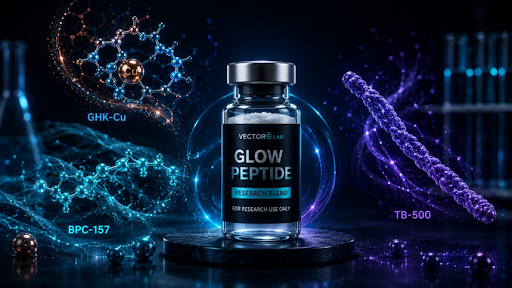
The market phrase "glow peptide" is typically used for research formulations that contain three peptides: TB-500, BPC-157, and GHK-Cu. These mixtures are explored in skin, tissue, and regenerative studies since each element is linked to a distinct biological pathway.
Glow Peptide discussions should be handled carefully. Strong clinical data from human trials is lacking for the formulation as a whole. The majority of existing evidence is derived from research on the separate peptide components. Therefore, Glow Peptide should not be regarded as an approved treatment, cosmetic therapy, or health product, but rather as a research formulation.
The FDA has raised safety concerns regarding various compounded peptides, including BPC-157, TB-500, and injectable GHK-Cu, citing concerns like immunogenicity risk, peptide impurities, aggregation, and insufficient human safety data (U.S. Food and Drug Administration, 2026).
What Is Glow Peptide?
In research discussions, Glow Peptide typically refers to a blend of multiple peptides that includes:
GHK-Cu: a tripeptide that binds copper,
BPC-157: a synthetic pentadecapeptide,
TB-500: a synthetic peptide often associated with thymosin beta-4 studies.
The combination might create an experimental setting for investigating various peptide-related pathways within the identical research framework. GHK-Cu is primarily addressed in studies related to skin regeneration and extracellular matrix. BPC-157 is researched in models of tissue preservation and vascular response. TB-500 is addressed concerning actin modulation, cellular movement, and regenerative biology.
However, a combination does not ensure proven synergy. There is a lack of blend-specific clinical evidence. It is necessary to present any claims on mixed effects as exploratory.
Why Researchers Study Glow Peptide?
Researchers are intrigued by Glow Peptide as it combines three peptide categories, each with distinct research profiles.
Main research domains comprise:
models for skin remodeling,
signaling of the extracellular matrix,
pathways associated with collagen,
models for wound healing,
vascular-response research,
studies on tissue protection,
cell movement and healing biology.
In skin biology and gene expression pathways linked to tissue remodeling, GHK-Cu's regenerative and protective properties have been investigated (Pickart & Margolina, 2018). BPC-157 has been examined in models of gastrointestinal protection, vascular response, and organ protection, although a significant portion of the evidence is still preclinical or experimental (Sikiric et al., 2024). TB-500 and thymosin beta-4 are being studied for their potential to cure musculoskeletal problems and mend tissues, although recent evaluations show that the evidence in humans is still limited and inconsistent (McGuire et al., 2026).
How Glow Peptide May Work?
Glow Peptide relies on many mechanisms. The possible overlap of three peptide routes is the source of its research attention.
GHK-Cu and Skin Remodeling: GHK-Cu is a peptide that naturally binds to copper. Its function in skin biology, extracellular matrix maintenance, collagen-related signaling, antioxidant functions, and pathways of tissue remodeling is examined. According to data reviews, GHK-Cu may have an impact on gene-expression patterns associated with protective and repair processes (Pickart & Margolina, 2018).
In the formulation, GHK-Cu can be examined concerning skin-model biology, signaling of the extracellular matrix, and science of formulations, instead of being used as a treatment for wounds, hair loss, or diseases.
BPC-157 and Tissue-Protection Models: BPC-157 is researched for its protective effects on cells and tissues. Studies explore its potential involvement in angiogenesis, vascular stability, gut protection, and injury-response scenarios. Although BPC-157 is a peptide with broad experimental importance, its use in clinical settings is currently limited, according to a 2024 study (Sikiric et al., 2024).
BPC-157 should be classified as a research-phase element for Glow Peptide content. It cannot be marketed as a therapeutic peptide or recognized healing agent.
TB-500, Thymosin Beta-4, and Cell Migration: TB-500 is frequently mentioned concerning the biology of thymosin beta-4. Functional short peptide sequences found in thymosin beta-4 are involved in angiogenesis, actin binding, cell migration, and wound repair signaling (Sosne et al., 2010).
A recent scoping review indicated that TB4 and TB-500 are commonly referenced in tissue healing and musculoskeletal recovery; however, the evidence is inconsistent, showing more robust preclinical findings compared to human clinical data (McGuire et al., 2026). As a result, TB-500 is no longer a therapeutically proven repair therapy but rather a peptide of research interest.

Quality Testing for Research Blends
Multi-peptide combinations present extra challenges in terms of quality. A single-peptide product requires confirmation of just one active sequence. Each component of a combination must be examined separately to guarantee that the final blend is consistent.
A reliable research blend must consist of:
peptide identification testing,
purity analysis through HPLC or UHPLC,
confirmation through mass spectrometry,
Certificate of Analysis specific to the batch,
clear blend ratio,
reconstitution instructions,
storage guidance,
labeling intended solely for research purposes.
Being pure solely is not enough. A mixture may look clear on one chromatogram yet still fail to adequately confirm each peptide. Both identification and purity must be documented in order to guarantee the validity of the research.
Route and Handling in Research
Glow Peptide blends are typically referred to as lyophilized research substances that need reconstitution prior to laboratory application. They require cautious handling, storage, and reconstitution conditions because of their peptide components.
Key considerations for handling include:
avoid constant temperature cycling.
protect from contamination,
utilize suitable diluent as specified in the protocol,
record lot number and date of reconstitution,
adhere to sterile research techniques,
refrain from using unsupported dosing or claims.
Any discussion regarding administrative routes have to remain within the context of research. It must not suggest approved human use.
Safety and Regulatory Status
The FDA has not approved Glow Peptide as a combination product for any medicinal use. Its components also require careful regulatory structuring. Concerns about peptide contaminants or possible immunogenicity, as well as a lack of safety data, have led the FDA to identify safety concerns with compounded medicines containing BPC-157, TB-500, and injectable GHK-Cu (U.S. Food and Drug Administration, 2026).
This does not imply that these peptides lack research significance. This suggests that claims must be supported by facts. Research interest does not equate to approval, and preclinical findings should not be translated into claims about consumer therapy.
Future Outlook
Glow Peptide is best described as a research-phase multi-peptide mixture centered on GHK-Cu, BPC-157, and TB-500. The scientific basis arises from the distinct pathways of its components such as skin regeneration, tissue protection, vascular reaction, and cell movement.
Glow Peptide is a research formulation with minimal blend-specific human data. Molecular identity, analytical confirmation, regulatory thresholds, and careful interpretation of existing research should be the main focus of meaningful discussion.
Frequently Asked Questions
1. What is Glow Peptide? “Glow Peptide” refers to a commercial term that typically denotes research blends featuring GHK-Cu, BPC-157, and TB-500-associated substances. It is not an established pharmaceutical classification.
2. What peptides are usually included in the Glow Peptide blend? The assessed formulation includes GHK-Cu, BPC-157, and TB-500. Every component possesses a distinct experimental research background and must be characterized separately.
3. What is Glow Peptide being researched for? The components are examined in studies related to skin-model biology, signaling of the extracellular matrix, vascular reactions, cell movement, and tissue response pathways.
4. Is the Glow Peptide combination clinically proven? No. Human data for the combination are quite limited, and evidence from the individual components does not demonstrate that the blend has additive or synergistic effects.
5. What testing is important for a multi-peptide research blend? Researchers should consider identity testing for every component, HPLC/UHPLC analysis, mass-spectrometry verification, blend ratio, batch-specific records, and lot traceability.
References
McGuire, F., Hughes, E., Maak, T., & Cushman, D. M. (2026). Thymosin beta-4 and TB-500 in tissue healing, regeneration, and musculoskeletal repair: A scoping review. Applied Sciences, 16(12), Article 6202. https://doi.org/10.3390/app16126202
Pickart, L., & Margolina, A. (2018). Regenerative and protective actions of the GHK-Cu peptide in the light of the new gene data. International Journal of Molecular Sciences, 19(7), Article 1987. https://doi.org/10.3390/ijms19071987
Sikiric, P., Sever, M., Krezic, I., Vranes, H., Kalogjera, L., Smoday, I. M., Vukovic, V., Oroz, K., Zubcic, S., & Sikiric, S. (2024). New studies with stable gastric pentadecapeptide protecting gastrointestinal tract, significance of counteraction of vascular and multiorgan failure of occlusion/occlusion-like syndrome in cytoprotection/organoprotection. Inflammopharmacology, 32, 3119–3161. https://doi.org/10.1007/s10787-024-01566-0
Sosne, G., Qiu, P., Goldstein, A. L., & Wheater, M. (2010). Biological activities of thymosin β4 defined by active sites in short peptide sequences. FASEB Journal, 24(7), 2144–2151. https://doi.org/10.1096/fj.09-142307
U.S. Food and Drug Administration. (2026). Certain bulk drug substances for use in compounding that may present significant safety risks. https://www.fda.gov/drugs/human-drug-compounding/certain-bulk-drug-substances-use-compounding-may-present-significant-safety-risks