

Peptide Science
KPV Peptide: Structure, Properties, Mechanism, Research, and Future Outlook
Introduction
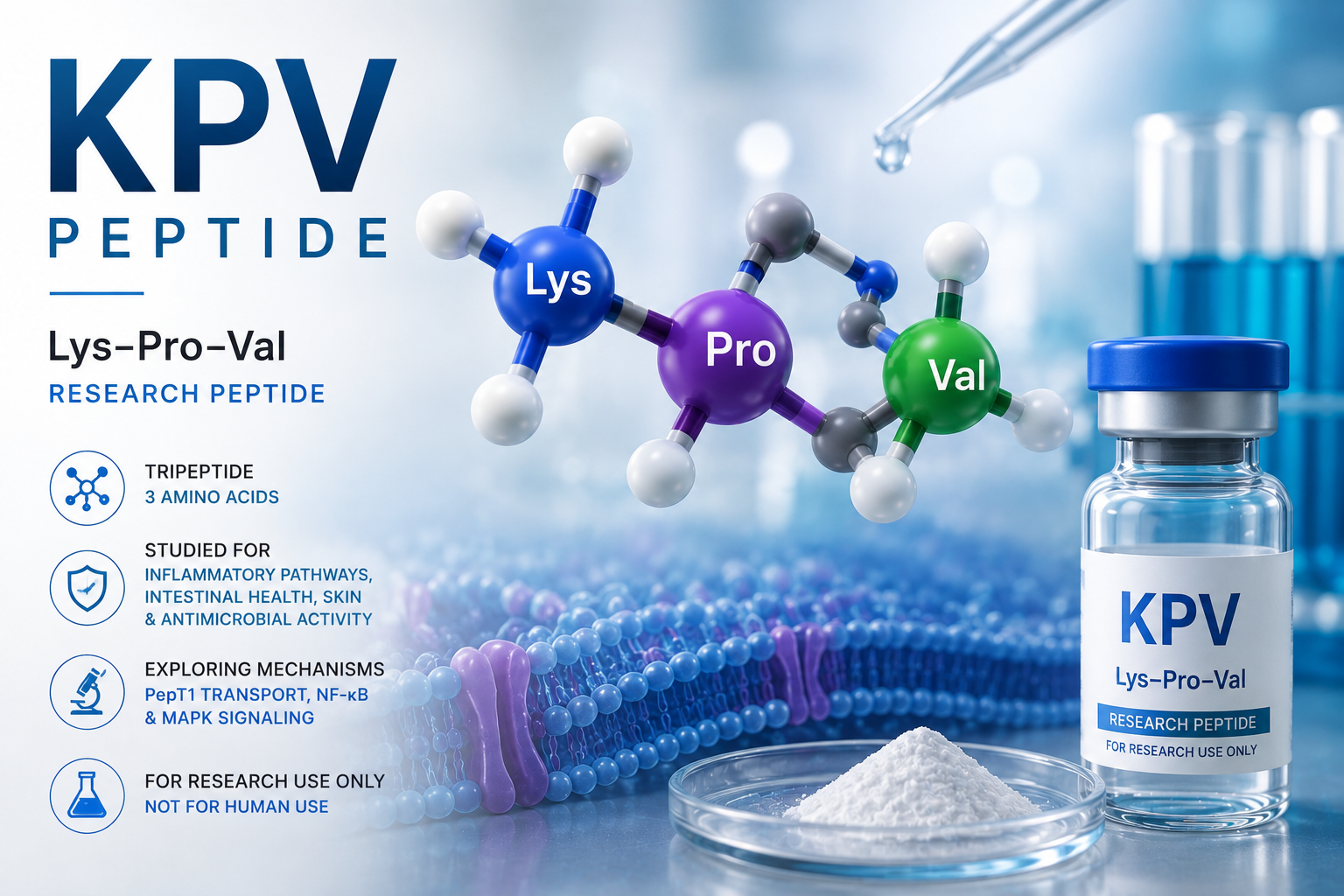
KPV is a short peptide that consists of just three amino acids: valine, proline, and lysine. The short sequence has attracted attention since KPV has shown notable effects in lab models related to inflammatory signaling, intestinal cells, skin cells, and specific microorganisms. The majority of the evidence that exists is preclinical. KPV should thus be regarded as an experimental tripeptide, rather than an established therapy.
What Is KPV?
KPV is the three-amino-acid sequence found at the C-terminus of alpha-melanocyte-stimulating hormone (α-MSH), which corresponds to residues 11–13. α-MSH is a naturally occurring peptide that has various biological functions. Researchers were drawn to KPV because it is a much smaller peptide that shows biological action without replicating the entire signaling profile of α-MSH (Getting et al., 2003).
A key distinction is that KPV seems not to rely on the traditional melanocortin-receptor signaling utilized by numerous α-MSH effects. Getting et al. (2003) found that KPV activity persisted in a mouse model of inflammation despite the presence or inhibition of specific melanocortin pathways. One possible explanation, according to the authors, could be interference with the functions of interleukin-1 beta (IL-1β). KPV's exact direct molecular target is still unknown.
Structure and Basic Properties
The KPV sequence consists of L-lysine–L-proline–L-valine, frequently denoted as H-Lys-Pro-Val-OH. It is categorized as a tripeptide since it consists of three amino acids.
The FDA’s 2026 scientific review specifies KPV free base, which has the molecular formula C₁₆H₃₀N₄O₄ and an approximate molecular weight of 342.43 Da. KPV acetate was evaluated by the FDA as a separate bulk drug substance. Although the two versions are not chemically equivalent, they share the same peptide structure (U.S. Food and Drug Administration [FDA], 2026a).
That differentiation is crucial for reproducibility in research. A peptide sample cannot be fully described by a product name alone. The exact chemical form, peptide sequence, terminal chemistry, lot number, purity procedure, and molecular identification test must all be documented by researchers. While mass spectrometry helps confirm molecular identity, HPLC provides information about chromatographic purity.
How Is KPV Thought to Work?
No definitive mechanism has been established that accounts for all documented KPV effects. One notable finding concerns peptide transporter 1, or PepT1. Small dipeptides and tripeptides are transported by PepT1 across cell membranes, primarily in the intestinal system.
According to Dalmasso et al. (2008), KPV can enter T cells and intestinal epithelial cells through PepT1. In the same experimental study, exposure to KPV was linked to decreased activation of NF-κB and MAPK pathways and to a reduced production of specific inflammatory mediators. Signaling pathways like NF-κB and MAPK help cells respond to stress and immunological stimuli.
Although these findings are useful in terms of mechanism, they still need to be linked to the models in which they were observed. They do not prove that KPV manages inflammatory disease in humans.
What Has KPV Been Studied For?
Intestinal and Delivery Research
One of the areas of KPV that has been studied the most is the gastrointestinal tract. Scientists have looked into whether the formulation can improve the transport of KPV to inflammatory intestinal regions in addition to the PepT1 experiments. In order to study the system in intestinal cells and a mouse model of colitis, Xiao et al. (2017) encapsulated KPV in polymeric nanoparticles modified with hyaluronic acid. In that model, the formulation altered tissue targeting and was linked to alterations in mucosal and inflammatory markers.
This study is particularly valuable from a formulation viewpoint. It indicates that peptide administration, cellular absorption, and localized exposure can influence the outcome of an experiment. Results from a peptide supplied by a nanoparticle should not be compared to those from free KPV.
Skin and Barrier-Tissue Research
KPV has been studied in models related to epithelial tissue and skin. After KPV treatment, Sung et al. (2025) observed changes in reactive oxygen species, MAPK signaling, NF-κB signaling, and IL-1β-associated responses in human HaCaT keratinocytes exposed to particulate matter. A three-dimensional skin model was also used in the research. These are results from the laboratory rather than from clinical outcomes.
A rabbit model for corneal damage was used in earlier research. Bonfiglio et al. (2006) noted accelerated re-epithelialization in rabbit corneas treated with KPV and explored nitric oxide signaling as a potential factor. Although this result should not be directly applied to assertions about human wound healing, it does encourage further investigation on KPV in epithelial-response frameworks.
Antimicrobial Research
KPV has additionally been evaluated against specific microorganisms. According to Cutuli et al. (2000), KPV affected Candida albicans viability and germ-tube formation under the experimental conditions and reduced the growth of Staphylococcus aureus colonies. These findings back the characterization of KPV as possessing antimicrobial properties in specific in-vitro models. They do not demonstrate wide-ranging antimicrobial effectiveness or practical value in treating infections.
What KPV Research Shows—and What Still Needs to Be Studied?
Studies on gut cells, epithelial tissues, inflammatory signals, and specific microbes have shown that KPV is active in both lab and animal settings. However, a large portion of the current research is still in the preclinical stage and should not be regarded as established human effects.
In its evaluation for 2026, the FDA stated that it had not found clinical pharmacokinetic, pharmacodynamic, or verified human exposure information for KPV free base or KPV acetate (U.S. Food and Drug Administration [FDA], 2026a).
Studying conditions are also crucial. PepT1 transport, NF-κB, MAPK, and cytokine signaling results differ according to cell type, peptide variation, concentration, mode of delivery, and experimental model used (Dalmasso et al., 2008).
Researchers find it most beneficial to examine the specific form of KPV that was evaluated, the experimental model employed, peptide concentration, mode of delivery, analytical identity, and the biological endpoint assessed. These details help differentiate between broad conclusions that have not yet been verified and well-supported laboratory results.
While current research provides a useful basis for studying KPV, more work is required to clarify its molecular targets, metabolic pathways, stability, safety evaluation, and relevance in human models.
Current U.S. Regulatory Status
The FDA has not authorized KPV as a medication. KPV free base and KPV acetate were evaluated by FDA staff in 2026 for possible inclusion on the Section 503A Bulk Drug drugs List. They concluded in their briefing document that the current criteria advocated against listing the drugs (FDA, 2026a).
During the Pharmacy Compounding Advisory Committee meeting on July 23–24, 2026, the committee advised adding KPV to the 503A list. The suggestion is advisory and non-binding; it does not decide clinical safety, effectiveness, or dosage, nor does it indicate FDA drug approval (FDA, 2026b; Liang, 2026). As a result, KPV should continue to be listed as an unapproved research compound.
Why Material Quality Matters?
KPV investigation relies on understanding which material was truly evaluated. According to the FDA's evaluation, KPV-related materials had inconsistent names and inadequate descriptions (FDA, 2026a). A valuable Certificate of Analysis for research purposes should specify the peptide sequence and chemical form while including lot-specific analytical details. HPLC purity combined with an appropriate identity method like mass spectrometry provides more insight than a purity percentage on its own.
Future Outlook
Future KPV research will probably concentrate on more defined molecular targets, PepT1-dependent absorption, stability and metabolism, contrasts between free-base and salt variants, and enhanced delivery methods. Improved toxicological data and human-relevant tissue models would help identify which preclinical results are repeatable and biologically significant.
The most effective research questions are precise: Which KPV version was evaluated? Did the peptide have a complete chemical structure? Did the model contain PepT1? Which signaling pathway was altered? Did the formulation change local exposure? By answering these questions, future KPV research from other laboratories will be easier to compare.
Final Perspective
KPV is a straightforward tripeptide with an unexpectedly extensive preclinical research history. Research links it to PepT1 transport, NF-κB and MAPK signaling, epithelial reactions, and certain antimicrobial properties. Simultaneously, direct data on human pharmacology and safety continue to be inadequate.
For researchers, the most effective method is to accurately define the molecule, confirm its analytical identity, clearly present the experimental model, and distinguish laboratory observations from clinical interpretations.
Frequently Asked Questions
What is KPV peptide? KPV is a short research peptide consisting of three amino acids: lysine, proline, and valine. It originates from the C-terminal region of alpha-melanocyte-stimulating hormone (α-MSH).
How does KPV peptide work? Research indicates that KPV might enter specific cells via the PepT1 transporter and affect signaling pathways like NF-κB and MAPK. These results primarily originate from animal studies and laboratory research.
What is KPV peptide being studied for? KPV research has centered on gut signaling, epithelial and skin models, inflammatory pathways, peptide transport, and specific antimicrobial effects. These areas continue to be mostly preclinical.
Is KPV peptide FDA approved? No. KPV is not approved by the FDA as a drug. It has been examined concerning the Section 503A Bulk Drug Substances List, but this evaluation does not determine clinical safety, efficacy, or approved use.
What is the difference between KPV free base and KPV acetate? Both feature the identical KPV peptide sequence, yet they represent distinct chemical forms. This differentiation can be significant in studies as the form of the peptide and its analytical identity might affect the reproducibility of experiments.
References
Bonfiglio, V., Camillieri, G., Avitabile, T., Leggio, G. M., & Drago, F. (2006). Effects of the COOH-terminal tripeptide alpha-MSH(11–13) on corneal epithelial wound healing: Role of nitric oxide. Experimental Eye Research, 83(6), 1366–1372. https://doi.org/10.1016/j.exer.2006.07.014
Cutuli, M., Cristiani, S., Lipton, J. M., & Catania, A. (2000). Antimicrobial effects of alpha-MSH peptides. Journal of Leukocyte Biology, 67(2), 233–239. https://doi.org/10.1002/jlb.67.2.233
Dalmasso, G., Charrier-Hisamuddin, L., Nguyen, H. T. T., Yan, Y., Sitaraman, S., & Merlin, D. (2008). PepT1-mediated tripeptide KPV uptake reduces intestinal inflammation. Gastroenterology, 134(1), 166–178. https://doi.org/10.1053/j.gastro.2007.10.026
Getting, S. J., Schiöth, H. B., & Perretti, M. (2003). Dissection of the anti-inflammatory effect of the core and C-terminal (KPV) alpha-melanocyte-stimulating hormone peptides. Journal of Pharmacology and Experimental Therapeutics, 306(2), 631–637. https://doi.org/10.1124/jpet.103.051623
Liang, L. (2026). Peptides: US advisory committee recommends six for FDA “compounding list.” BMJ, 394, e100422. https://doi.org/10.1136/bmj-2026-100422
Sung, J., Ju, S.-Y., Park, S., Jung, W.-K., Je, J.-Y., & Lee, S.-J. (2025). Lysine-proline-valine peptide mitigates fine dust-induced keratinocyte apoptosis and inflammation by regulating oxidative stress and modulating the MAPK/NF-κB pathway. Tissue and Cell, 95, 102837. https://doi.org/10.1016/j.tice.2025.102837
U.S. Food and Drug Administration. (2026a, May 12). Evaluation of KPV-related bulk drug substances (KPV [free base] and KPV acetate) for inclusion on the 503A Bulk Drug Substances List [Briefing document]. https://www.fda.gov/media/193346/download
U.S. Food and Drug Administration. (2026b, July 23–24). July 23–24, 2026: Meeting of the Pharmacy Compounding Advisory Committee. https://www.fda.gov/advisory-committees/advisory-committee-calendar/july-23-24-2026-meeting-pharmacy-compounding-advisory-committee-07232026
Xiao, B., Xu, Z., Viennois, E., Zhang, Y., Zhang, Z., Zhang, M., Han, M. K., Kang, Y., & Merlin, D. (2017). Orally targeted delivery of tripeptide KPV via hyaluronic acid-functionalized nanoparticles efficiently alleviates ulcerative colitis. Molecular Therapy, 25(7), 1628–1640. https://doi.org/10.1016/j.ymthe.2016.11.020