

Peptide Science
Retatrutide Overview: Key Information for Consumers and Researchers Regarding the Triple-Receptor Agonist
Introduction
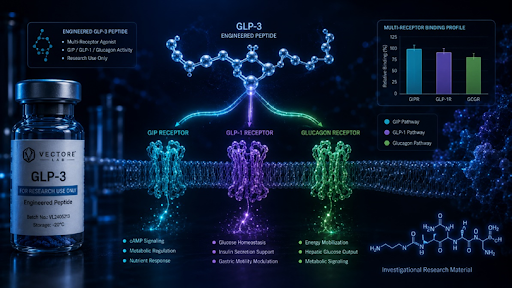
In the realm of metabolic studies, retatrutide is one of the peptides that is most frequently observed. It does not qualify as a typical GLP-1 medication. It functions as an agonist for three hormone receptors. This suggests that three receptors—GIP, GLP-1, and glucagon—are meant to be stimulated by a single molecule.
This is crucial since there is no one pathway that can be used to treat metabolic problems and obesity. Appetite, insulin reaction, energy consumption, liver function, fat accumulation, and body weight control function harmoniously. Retatrutide was designed to attack several systems at once (Jastreboff et al., 2023).
Retatrutide is best characterized as an investigational metabolic peptide that has significant clinical research progress. It has not received FDA approval and should not be regarded as accessible for public or regular clinical use.
What Is Retatrutide?
Retatrutide is a synthetic peptide created by Eli Lilly. The molecule is intended for subcutaneous administration once a week in clinical trials (Eli Lilly and Company, 2026a).
Retatrutide is referred to as a triple agonist due to its ability to activate:
GLP-1 receptor
GIP receptor
Glucagon receptor
Insulin production that is dependent on glucose levels, delayed stomach emptying, and appetite regulation are all linked to GLP-1 receptor activation. Activation of GIP receptors could enhance insulin response and regulate metabolism. Glucagon receptor activation may increase energy expenditure and impact liver and fat metabolism (Coskun et al., 2022; Katsi et al., 2025).
This triple mechanism is the primary factor that distinguishes retatrutide from single-pathway GLP-1 medications.
Structure and Molecular Identity
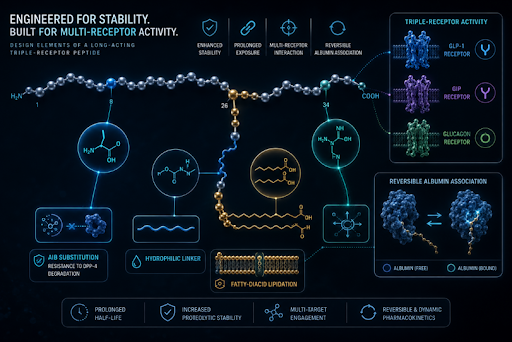
The GIP peptide structure is the main source of retatrutide, a synthetic single-chain peptide. It includes strategic alterations in amino acids that enhance receptor function and metabolic stability. Lipidation, which helps to extend circulation time, is another aspect of it.
PubChem categorizes retatrutide-related molecular information as “Triple G,” featuring the formula C221H342N46O68 and a molecular weight of approximately 4731 g/mol (National Center for Biotechnology Information [NCBI], 2026).
Three key engineering concepts are present in the molecule:
DPP-4 Resistance: Retatrutide includes 2-aminoisobutyric acid, referred to as Aib. This synthetic amino acid helps protect the peptide from DPP-4's rapid enzymatic degradation. This promotes extended activity following administration.
Receptor Optimization: Changes in specific amino acids modify the function of the GIP, GLP-1, and glucagon receptors. The objective is not just strong receptor attachment. The objective is consistent signaling.
Lipidation for Longer Half-Life: Retatrutide features a fatty diacid side chain linked via linker chemistry. This facilitates reversible binding of albumin. In trials, albumin binding lowers renal clearance and makes once-weekly dosage more feasible (Coskun et al., 2022; Katsi et al., 2025).
Physical and Chemical Properties
In research and clinical development, retatrutide is considered as a potential peptide medication. Research-quality peptide material is usually provided as a white to off-white freeze-dried powder.
Main technical aspects consist of:
the identity of the peptide must be verified through mass spectrometry,
purity must be evaluated using HPLC or UHPLC,
Reconstituted solutions tend to be less stable than lyophilized powder.
storage must shield against heat, humidity, and light,
Formulation conditions are influenced by the type of salt, buffer system, pH level, and concentration.
Not every retatrutide material has the same pH. The specific product being manufactured, the excipients employed, and stability data all affect the pH of formulation. Researchers must avoid replicating pH values from supplier catalogs without proper analytical support.
How Retatrutide Works?
Retatrutide functions by targeting three metabolic receptors.
GLP-1 Receptor Activity: GLP-1 signaling promotes fullness and reduces hunger. Insulin secretion, which is dependent on glucose levels, is also facilitated by it. This indicates that insulin response enhances when glucose levels rise, which is significant in metabolic studies (Jastreboff et al., 2023).
GIP Receptor Activity: GIP signaling may promote fat-tissue metabolism, support beta-cell function, and increase insulin sensitivity. GIP and GLP-1 could work together to create multi-agonist peptides that improve metabolic responsiveness.
Glucagon Receptor Activity: Glucagon signaling is the distinguishing characteristic that sets retatrutide apart from dual agonists. The activity of the glucagon receptor might enhance energy expenditure and facilitate fat oxidation. This is one reason why researchers are investigating retatrutide for obesity and liver-metabolism effects (Coskun et al., 2022; Katsi et al., 2025).
In straightforward terms, retatrutide aims to influence both aspects of weight control: calorie intake and energy expenditure.
Clinical Research Update
Retatrutide has advanced through human clinical trials for metabolic conditions. Published research has indicated alterations in body weight and metabolic outcomes in specific clinical groups. These results pertain to the experimental drug utilized within controlled clinical guidelines and should not be generalized to research-grade retatrutide substances.
Route of Administration
In clinical studies, retatrutide is administered via subcutaneous injection on a weekly basis. Since many peptides are broken down in the digestive system when taken orally, this pathway is common for peptide drugs.
Clinical protocols employ incremental dose increases. This aids in enhancing gastrointestinal tolerance. Constipation, nausea, vomiting, diarrhea, and decreased appetite are common side effects of incretin-based therapies. The safety of retatrutide is still being assessed in current research (Jastreboff et al., 2023; Eli Lilly and Company, 2026a).
Regulatory Status
Retatrutide is currently under investigation. As of mid-2026, it has not received FDA approval for obesity, diabetes, liver disease, sleep apnea, or any other condition. According to Eli Lilly, retatrutide is not currently accessible for public use (Eli Lilly and Company, 2026a).
Why Quality Standards Matter?
The structure of retatrutide is intricate. It involves substituting non-natural amino acids, designing receptor-specific sequences, linker chemistry, and incorporating lipids. Analytical testing is therefore crucial.
For research involving peptides, quality must encompass:
Certificate of analysis specific to the batch,
HPLC or UHPLC purity information,
confirmation of identity via mass spectrometry,
checks for residual solvents when applicable,
testing for water content when applicable,
clear lot traceability,
documentation for storage and handling.
From a research viewpoint, peptide-related information must be evidence-based, backed by clear analytical data, and conveyed with careful consideration of scientific limitations and regulatory conditions.
Future Outlook
Retatrutide signifies the advancement in incretin peptide studies. GLP-1 medications that target a single receptor are giving way to platforms that interact with several receptors. The objective is more comprehensive metabolic regulation, instead of just appetite suppression.
Current research is assessing retatrutide for obesity, type 2 diabetes, obstructive sleep apnea, knee osteoarthritis, cardiovascular results, kidney outcomes, and metabolic dysfunction-associated fatty liver disease (ClinicalTrials.gov, 2026a; ClinicalTrials.gov, 2026b).
Currently, retatrutide should be considered a investigational multi-receptor agonist undergoing clinical evaluation that is undergoing regulatory evaluation and exhibiting significant clinical signs. It is not a product that is approved for use by customers.
Frequently Asked Questions
1. What is retatrutide? Retatrutide is an experimental peptide intended to stimulate GLP-1, GIP, and glucagon receptors in one molecular framework.
2. Why is retatrutide called a triple-receptor agonist? It is referred to as a triple agonist due to its pharmacological design that engages three receptor systems: GLP-1R, GIPR, and the glucagon receptor.
3. Is retatrutide FDA approved? No. Retatrutide is still in the experimental stage and has not received FDA approval as a finalized drug product.
4. Is retatrutide the same as a standard GLP-1 agonist? No. Standard GLP-1 receptor agonists focus on GLP-1R, whereas retatrutide is under research for its combined activity on GLP-1, GIP, and glucagon receptors.
5. What should researchers verify in retatrutide material? Key characteristics consist of molecular identity, HPLC/UHPLC purity, mass spectrometry validation, peptide-associated impurities, water or residual solvent information, and batch traceability.
References
ClinicalTrials.gov. (2026a). A study of retatrutide (LY3437943) in participants who have obesity or overweight (ClinicalTrials.gov Identifier NCT05929066). U.S. National Library of Medicine. Retrieved June 29, 2026, from https://clinicaltrials.gov/study/NCT05929066
ClinicalTrials.gov. (2026b). A study of retatrutide (LY3437943) in participants with type 2 diabetes who have obesity or overweight (ClinicalTrials.gov Identifier NCT05929079). U.S. National Library of Medicine. Retrieved June 29, 2026, from https://clinicaltrials.gov/study/NCT05929079
Coskun, T., Urva, S., Roell, W. C., Qu, H., Loghin, C., Moyers, J. S., O’Farrell, L. S., Briere, D. A., Sloop, K. W., Thomas, M. K., Pirro, V., Wainscott, D. B., Willard, F. S., Abernathy, M., Morford, L., Du, Y., Benson, C., Gimeno, R. E., Haupt, A., & Milicevic, Z. (2022). LY3437943, a novel triple glucagon, GIP, and GLP-1 receptor agonist for glycemic control and weight loss: From discovery to clinical proof of concept. Cell Metabolism, 34(9), 1234–1247.e9. https://doi.org/10.1016/j.cmet.2022.07.013
Eli Lilly and Company. (2026a, May 21). Lilly’s triple agonist, retatrutide, delivered powerful weight loss in pivotal Phase 3 obesity trial [Press release]. https://investor.lilly.com/news-releases/news-release-details/lillys-triple-agonist-retatrutide-delivered-powerful-weight-loss
Eli Lilly and Company. (2026b, June). What to know about retatrutide. https://www.lilly.com/news/stories/what-to-know-about-retatrutide
Jastreboff, A. M., Kaplan, L. M., Frías, J. P., Wu, Q., Du, Y., Gurbuz, S., Coskun, T., Haupt, A., Milicevic, Z., & Hartman, M. L. (2023). Triple–hormone-receptor agonist retatrutide for obesity—A phase 2 trial. The New England Journal of Medicine, 389(6), 514–526. https://doi.org/10.1056/NEJMoa2301972
Katsi, V., Koutsopoulos, G., Fragoulis, C., Dimitriadis, K., & Tsioufis, K. (2025). Retatrutide—A game changer in obesity pharmacotherapy. Biomolecules, 15(6), Article 796. https://doi.org/10.3390/biom15060796
National Center for Biotechnology Information. (n.d.). PubChem compound summary for Triple G. PubChem. Retrieved June 29, 2026, from https://pubchem.ncbi.nlm.nih.gov/compound/Triple-G