

Peptide Science
TB-500 Peptide: Structure, Properties, Mechanism, Research, and Future Outlook
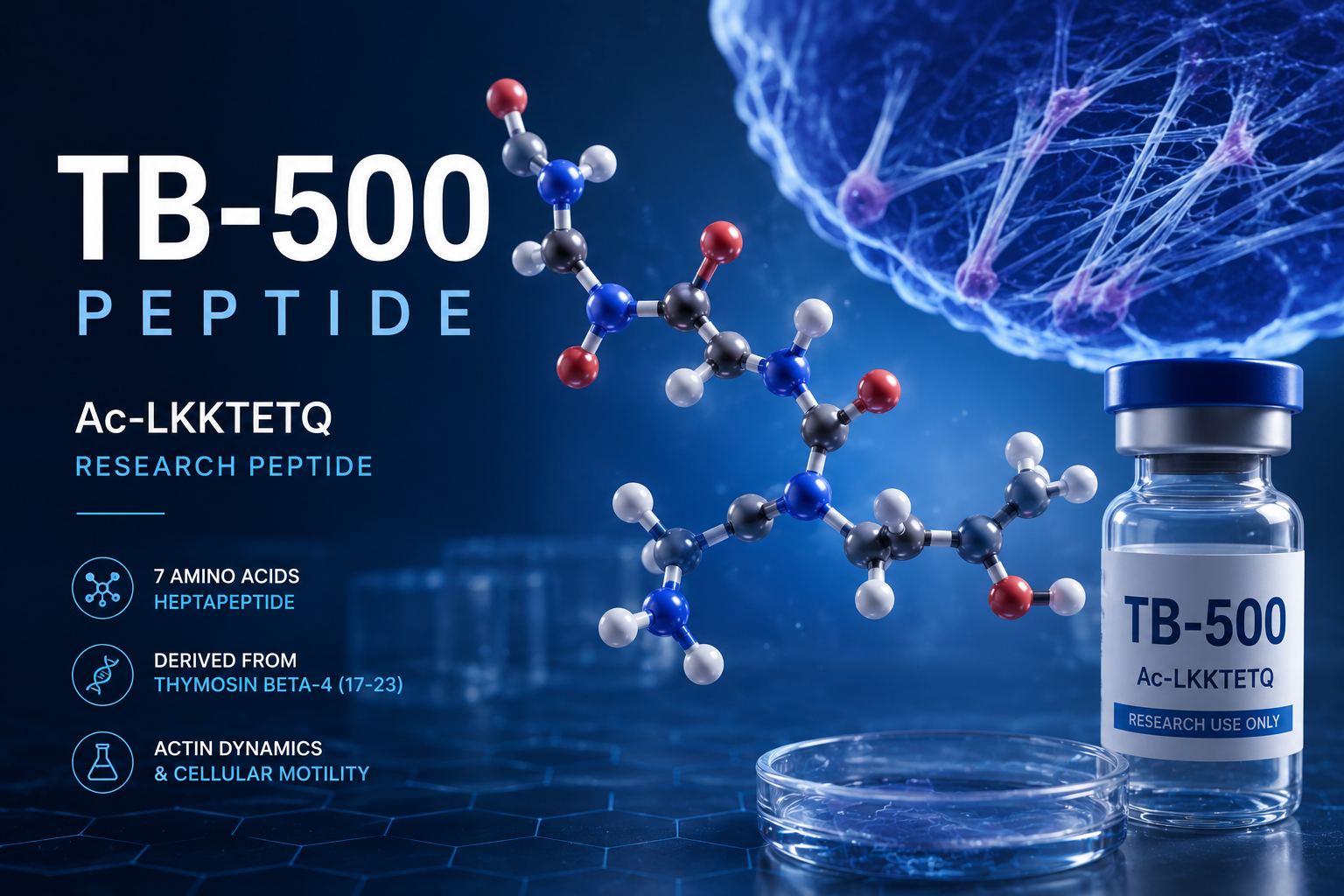
Introduction
TB-500 is a synthetic research peptide associated with thymosin beta-4 (Tβ4), a naturally existing peptide of 43 amino acids that plays a role in actin dynamics and cellular motility. TB-500 is often described as being the same as the full-length Tβ4 molecule. It is not. When examining the research, it is essential to keep that distinction.
Research on full-length Tβ4 is far more extensive than that on TB-500 alone. For researchers, TB-500 should be regarded as a unique experimental peptide, and its effects cannot be directly assumed from all Tβ4 research.
What Exactly Is TB-500?
The material widely recognized as TB-500 is the N-terminally acetylated seven-amino-acid chain Ac-Leu-Lys-Lys-Thr-Glu-Thr-Gln-OH, or Ac-LKKTETQ for short. This sequence corresponds to human thymosin beta-4 residues 17–23.
High-resolution mass spectrometry was used by Esposito et al. (2012) to identify Ac-LKKTETQ in a product marketed as TB-500. The 2026 FDA evaluation also characterizes TB-500 free base as the acetylated 17–23 fragment of Tβ4, while stating that “TB-500” is a generic term and that various salts or derivatives have been sold under this name (U.S. Food and Drug Administration [FDA], 2026a).
The problem with naming is significant. Instead of relying only on the product name, researchers must confirm the sequence, N-terminal acetylation, chemical structure, molecular identity, purity, and lot information.
Structure and Basic Properties
TB-500 is made up of seven amino acids, making it a heptapeptide. According to the FDA, TB-500 free base has a molecular weight of around 889.01 Da and the chemical formula is C₃₈H₆₈N₁₀O₁₄. The recommended molecular weight of TB-500 acetate, a single bulk medicinal molecule, is roughly 949.1 Da (FDA, 2026a).
In research characterization, HPLC offers data on chromatographic purity, whereas LC-MS or an alternative mass-spectrometric technique can assist in verifying molecular identity. It is important to observe that the presence of N-terminal acetylation and the distinction between acetate and free-base contribute to the chemical identity of material.
Why Thymosin Beta-4 Matters to TB-500 Research?
The interest in TB-500 derives from its connection to the central actin-binding domain of Tβ4. The full-length Tβ4 is a significant peptide that sequesters G-actin. It attaches to monomeric actin and helps regulate the amount of actin available for filament assembly, which is an essential process for cellular motility and shape (Domanski et al., 2004; Irobi et al., 2004).
This core actin-associated region contains the LKKTETQ sequence. An acetylated version of that short segment is TB-500. Although this link provides a scientific justification for investigating TB-500, it does not prove that the brief fragment mimics every function of the 43-amino-acid parent peptide.
How Is TB-500 Thought to Work?
The majority of mechanistic discussion about TB-500 starts with actin and cellular mobility. Actin contributes to the cellular structural framework and is constantly rearranged as cells migrate, alter their form, or respond to tissue injuries. Due to the involvement of the 17–23 region of Tβ4 in actin-related biology, researchers have evaluated short peptides with this sequence in migration, vessel sprouting, and tissue-response models.
A synthetic seven-amino-acid LKKTETQ fragment was studied in older mice by Philp, Badamchian, et al. (2003), who discovered wound-repair effects comparable to those shown with full-length Tβ4. Crucially, that paper outlines LKKTETQ, rather than the N-terminally acetylated Ac-LKKTETQ substance now frequently referred to as TB-500. Therefore, the result is relevant fragment evidence, but it should not be presented as definitive evidence of TB-500 activity.
According to another study, endothelial cell migration and vessel sprouting assays were impacted by the seven-amino-acid actin-binding motif (Philp, Huff, et al., 2003). Again, the discovery clarifies the interest in the Tβ4 17–23 area, yet it does not confirm a clinical impact of TB-500.
Cell Migration and Extracellular-Matrix Research
In lab models of keratinocyte migration, blood vessel development, and healing response, the full-length Tβ4 has been studied (Malinda et al., 1999). Matrix metalloproteinases, or MMPs, which are involved in the remodeling of the extracellular matrix, have also been investigated in the central 17–23 region. In experimental cell and wound models, Philp et al. (2006) discovered that the central actin-binding domain preserved MMP-inducing characteristics.
Understanding the biology of the parent peptide and its primary fragment is aided by these studies. They must not be restated as assertions that TB-500 has demonstrated regenerative or wound-healing properties in humans.
What Current TB-500 Research Tells Us?
This serves as the primary evidence boundary for TB-500. Many assertions about it are largely based on either non-acetylated LKKTETQ segments or full-length Tβ4. In its 2026 assessment, the FDA brought attention to this problem, pointing out that the data for TB-500 was based on thymosin beta-4 tests and failed to reference human clinical trials (FDA, 2026a).
FDA determined that the existing nonclinical pharmacology was insufficient to support the suggested wound-healing application of TB-500 and that there was a lack of nonclinical toxicology data (FDA, 2026a). This does not demonstrate that TB-500 lacks biological activity. This suggests that there is not enough data to draw firm judgments about the designated TB-500 substances.
Metabolism and Detection Research
One field with direct TB-500 data is analytical anti-doping studies. Ho et al. (2012) identified N-acetylated LKKTETQ along with various metabolites in equine plasma and urine following the administration of a TB-500 formulation. The research is helpful as it verifies that the parent peptide can be quantified post-exposure and that shorter metabolic byproducts are generated.
This brings up another study question: is a biological impact caused by intact Ac-LKKTETQ, one of its metabolites, or a combination of species? To answer that question, better pharmacokinetic and metabolic investigations are required.
Current U.S. Regulatory Status
TB-500 is not approved by the FDA as a drug. In 2026, FDA personnel assessed TB-500 free base and TB-500 acetate for potential addition to the Section 503A Bulk Drug Substances List and determined in their briefing document that the existing criteria did not support their listing (FDA, 2026a).
During the Pharmacy Compounding Advisory Committee meeting on July 23–24, 2026, the committee suggested adding TB-500 to the 503A list. The committee’s suggestion is advisory and not mandatory; it does not represent FDA authorization and does not validate clinical safety, efficacy, or dosage (FDA, 2026b; Liang, 2026).
TB-500 and Anti-Doping Rules
In athletics, TB-500 has a unique regulatory classification. Thymosin beta-4 and its derivatives, such as TB-500, are included in the growth-factor and growth-factor-modulator category of the World Anti-Doping Agency’s 2026 Prohibited List. It is prohibited for athletes according to WADA regulations (World Anti-Doping Agency [WADA], 2025). This status regarding anti-doping is distinct from FDA drug regulation.
Why Material Quality Matters
TB-500 research is particularly sensitive to chemical identity due to the inconsistent use of the common name. The FDA found inconsistencies in the TB-500 compounds' names and descriptions (FDA, 2026a). An effective research Certificate of Analysis must specify the sequence, terminal modification, molecular weight, peptide type, counterion where relevant, method of purity, and batch-specific test results.
The purity of HPLC by itself cannot verify the presence of the anticipated peptide. Merging a chromatographic purity approach with an orthogonal identity technique like mass spectrometry provides researchers with a more detailed characterization of the test substance.
Future Outlook
TB-500 is a fragment consisting of seven amino acids that is acetylated and associated with the central actin-binding region of thymosin beta-4. Although its connection to actin biology offers a strong molecular basis for research, there is significantly less direct evidence for TB-500 than for full-length Tβ4 and related fragments.
Future TB-500 studies should concentrate on the chemically defined Ac-LKKTETQ peptide rather than extrapolating from thymosin beta-4. Its direct interaction with actin, stability, metabolites, pharmacokinetics, toxicological, aggregation behavior, and whether free-base and salt forms behave differently in experimental settings are important topics.
Researchers must also identify which biological effects noted for LKKTETQ fragments persist following N-terminal acetylation. That differentiation is crucial for establishing a dependable TB-500 evidence foundation.
Frequently Asked Questions
What is TB-500 peptide? TB-500 is often recognized as the acetylated peptide composed of seven amino acids, Ac-LKKTETQ. It is derived from residues 17–23 of the naturally occurring peptide thymosin beta-4.
Is TB-500 the same as thymosin beta-4? No. Thymosin beta-4 in its full length comprises 43 amino acids, whereas TB-500 is a significantly shorter acetylated segment. Thus, the research findings from thymosin beta-4 cannot be directly applied to TB-500.
How does TB-500 peptide work? Research on TB-500 is primarily associated with the actin-related area of thymosin beta-4. Researchers are investigating how this area might affect actin-associated activities, cellular movement, and responses of the extracellular matrix.
What is TB-500 being studied for? TB-500 and related thymosin beta-4 fragments are being investigated in research focusing on actin dynamics, cell movement, tissue response pathways, metabolism, and the stability of peptides. Direct evidence for TB-500 is still less extensive compared to research on full-length thymosin beta-4.
Is TB-500 FDA approved? No. TB-500 is not an approved drug by the FDA. It has been assessed concerning the Section 503A Bulk Drug Substances List, although its clinical safety, efficacy, and approved dosing have not been established.
References
Domanski, M., Hertzog, M., Coutant, J., Gutsche-Perelroizen, I., Bontems, F., Carlier, M.-F., Guittet, E., & van Heijenoort, C. (2004). Coupling of folding and binding of thymosin beta4 upon interaction with monomeric actin monitored by nuclear magnetic resonance. Journal of Biological Chemistry, 279(22), 23637–23645. https://doi.org/10.1074/jbc.M311413200
Esposito, S., Deventer, K., Goeman, J., Van der Eycken, J., & Van Eenoo, P. (2012). Synthesis and characterization of the N-terminal acetylated 17–23 fragment of thymosin beta 4 identified in TB-500, a product suspected to possess doping potential. Drug Testing and Analysis, 4(9), 733–738. https://doi.org/10.1002/dta.1402
Ho, E. N. M., Kwok, W. H., Lau, M. Y., Wong, A. S. Y., Wan, T. S. M., Lam, K. K. H., Schiff, P. J., & Stewart, B. D. (2012). Doping control analysis of TB-500, a synthetic version of an active region of thymosin beta4, in equine urine and plasma by liquid chromatography–mass spectrometry. Journal of Chromatography A, 1265, 57–69. https://doi.org/10.1016/j.chroma.2012.09.043
Irobi, E., Aguda, A. H., Larsson, M., Guerin, C., Yin, H. L., Burtnick, L. D., Blanchoin, L., & Robinson, R. C. (2004). Structural basis of actin sequestration by thymosin-beta4: Implications for WH2 proteins. The EMBO Journal, 23(18), 3599–3608. https://doi.org/10.1038/sj.emboj.7600372
Liang, L. (2026). Peptides: US advisory committee recommends six for FDA “compounding list.” BMJ, 394, e100422. https://doi.org/10.1136/bmj-2026-100422
Malinda, K. M., Sidhu, G. S., Mani, H., Banaudha, K., Maheshwari, R. K., Goldstein, A. L., & Kleinman, H. K. (1999). Thymosin beta4 accelerates wound healing. Journal of Investigative Dermatology, 113(3), 364–368. https://doi.org/10.1046/j.1523-1747.1999.00708.x
Philp, D., Badamchian, M., Scheremeta, B., Nguyen, M., Goldstein, A. L., & Kleinman, H. K. (2003). Thymosin beta 4 and a synthetic peptide containing its actin-binding domain promote dermal wound repair in db/db diabetic mice and in aged mice. Wound Repair and Regeneration, 11(1), 19–24. https://doi.org/10.1046/j.1524-475x.2003.11105.x
Philp, D., Huff, T., Gho, Y. S., Hannappel, E., & Kleinman, H. K. (2003). The actin binding site on thymosin beta4 promotes angiogenesis. The FASEB Journal, 17(14), 2103–2105. https://doi.org/10.1096/fj.03-0121fje
Philp, D., Scheremeta, B., Sibliss, K., Zhou, M., Fine, E. L., Nguyen, M., Wahl, L., Hoffman, M. P., & Kleinman, H. K. (2006). Thymosin beta4 promotes matrix metalloproteinase expression during wound repair. Journal of Cellular Physiology, 208(1), 195–200. https://doi.org/10.1002/jcp.20650
U.S. Food and Drug Administration. (2026a, May 15). Evaluation of TB-500-related bulk drug substances (TB-500 [free base] and TB-500 acetate) for inclusion on the 503A Bulk Drug Substances List [Briefing document]. https://www.fda.gov/media/193349/download
U.S. Food and Drug Administration. (2026b, July 23–24). July 23–24, 2026: Meeting of the Pharmacy Compounding Advisory Committee. https://www.fda.gov/advisory-committees/advisory-committee-calendar/july-23-24-2026-meeting-pharmacy-compounding-advisory-committee-07232026
World Anti-Doping Agency. (2025). The 2026 prohibited list: International standard. https://www.wada-ama.org/sites/default/files/2025-09/202