

Peptide Science
Tirzepatide: A Researcher’s Guide to Dual GIP/GLP-1 Receptor Agonism
Introduction
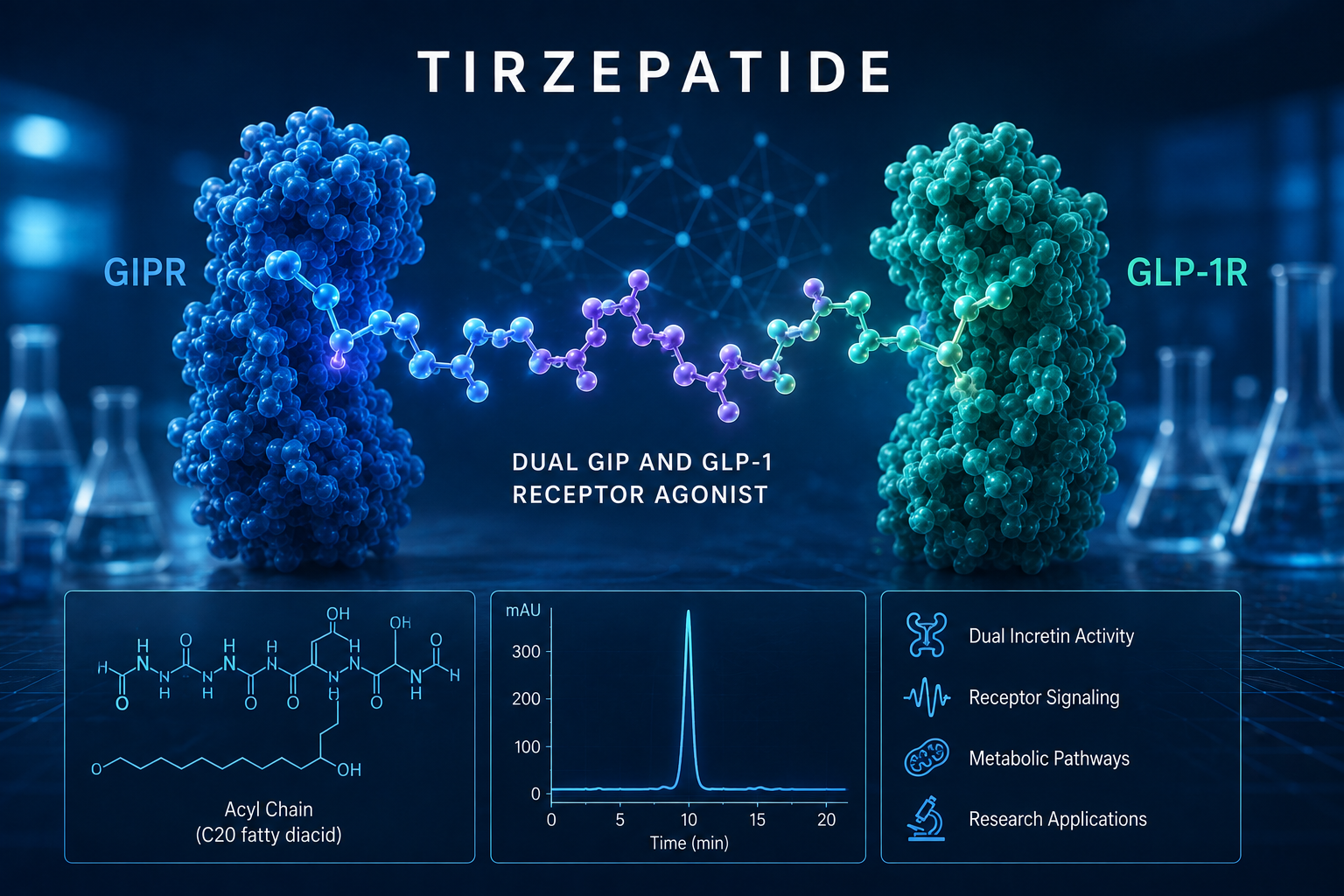
Tirzepatide is a modified, acylated peptide that acts as an agonist for the glucose-dependent insulinotropic polypeptide receptor (GIPR) and the glucagon-like peptide-1 receptor (GLP-1R). The pharmacology of this dual-receptor has rendered the molecule valuable for investigating incretin signaling, receptor bias, metabolic regulation, and contemporary peptide design (Coskun et al., 2018; Willard et al., 2020).
It is important to distinguish claims about independently supplied research-grade materials from clinical findings associated with tirzepatide products that have received FDA approval. Approval, clinical efficacy, dosage, and safety details belongs to particular finished pharmaceutical products and specified study parameters, not inherently to research substances.
What Is Tirzepatide?
Tirzepatide is a synthetic peptide with 39 amino acids that is derived from a GIP sequence and modified to activate GLP-1R and GIPR. In the approved pharmacological formulations, a C20 fatty-diacid group is linked by a linker to improve albumin binding and prolong systemic presence (Coskun et al., 2018).
Instead of just being a modified GLP-1 peptide, tirzepatide is better described in research communication as an altered dual GIPR/GLP-1R agonist.
Why Dual GIP and GLP-1 Receptor Activity Matters?
GIP and GLP-1 are incretin hormones involved in glucose-dependent hormonal signaling. Tirzepatide has a different pharmacological profile from selective GLP-1 receptor activation since it acts at both receptors in a single molecule (Coskun et al., 2018).
Additionally, tirzepatide exhibits traits of receptor-specific signaling. Experimental pharmacology suggests GIP-like activity at GIPR and biased signaling at GLP-1R, showing comparatively more cAMP signaling than β-arrestin recruitment and receptor internalization (Willard et al., 2020). Research is still being done on how these signaling traits affect individual clinical outcomes.
How Tirzepatide Works: Research-Based Mechanistic Context?
Glucose-Dependent Insulin Signaling
In both experimental and clinical settings, the activation of GIPR and GLP-1R has been associated with glucose-dependent insulin secretion. Dual-incretin modulation of pancreatic β-cell function and glucose regulation has been studied using tirzepatide (Coskun et al., 2018; Thomas et al., 2021).
Glucagon and Postprandial Regulation
Pharmacology related to GLP-1R can affect glucagon release and the regulation of glucose after meals. Rather than being universal properties of research-grade substances, these effects should be examined as receptor-mediated pharmacology observed in particular experimental or clinical settings.
Insulin Sensitivity
Clinical metabolic assessments have indicated alterations in insulin sensitivity and β-cell function metrics during tirzepatide therapy in adults with type 2 diabetes (Thomas et al., 2021). These findings are particular to the examined pharmaceutical intervention and group.
Gastric Emptying and Food-Intake Pathways
Gastric emptying and the signaling of food intake can be affected by GLP-1 receptor agonism. These pathways have been integrated into the broader incretin pharmacology framework of tirzepatide investigations. Formulation, exposure, study methodology, and population all influence the magnitude and duration of individual effects.
Clinical Evidence: Keep the Product Context Explicit
Tirzepatide has been evaluated in particular drug formulations and patient populations through randomized clinical trials. While SURMOUNT-1 examined tirzepatide in individuals who were obese or overweight, SURPASS-2 evaluated tirzepatide against semaglutide in adults with type 2 diabetes (Frías et al., 2021; Jastreboff et al., 2022). Subsequent clinical trials have assessed tirzepatide in further research groups, such as obesity, metabolic liver conditions, and heart failure related to obesity (Aronne et al., 2025; Loomba et al., 2024; Packer et al., 2025).
These results must not be shown as proof that research-grade tirzepatide has the same clinical efficacy, safety, stability, or pharmaceutical performance. The assessed end products, doses, production controls, participant groups, and methods are all linked to clinical results.
Current U.S. Regulatory Context
The FDA has approved tirzepatide as an active pharmaceutical ingredient for specific therapeutic applications in specific finished medicinal products. The FDA-reviewed formulations, manufacturing procedures, labeling, dosage schedules, and approved patient groups are all covered by these approvals. They should not be expanded to include independently supplied research-grade tirzepatide. Analytical identity by itself does not confirm pharmaceutical equivalence, product quality approval, clinical safety, or therapeutic efficacy.
Analytical Quality: What Researchers Should Verify
The entire quality of peptides cannot be ascertained by a single HPLC area-purity test. A characterization package centered on research might consist of:
Identity: Analysis based on orthogonal mass should verify the expected molecular species.
Chromatographic purity: The main peak and peptide-related impurities can be assessed using RP-HPLC or UPLC.
Peptide content: The chromatographic area percentage must not be regarded as equivalent with a quantitative peptide assay.
Water and nonpeptide mass: The mass balance may be impacted by residual solvents, counterions, and moisture.
Impurity profile: When applicable, stability-indicating methods must consider oxidation, hydrolysis, deamidation, truncation, epimerization, and acylation-associated variations.
Batch traceability: Analytical outcomes must be connected to the particular lot utilized in the experiment.
Stability and Handling Considerations
The stability of tirzepatide needs to be assessed with data specific to the peptide, formulation, and container. Peptide integrity may be affected by temperature, residual moisture, oxygen, light, pH, concentration, interactions with containers, and freeze-thaw exposure.
Storage statements for research-grade tirzepatide should not be taken straight from the label of an FDA-approved finished medication, but rather should be based on information gathered for the particular material.
Future Research Directions
Ongoing studies persist in investigating dual-incretin receptor pharmacology, biased receptor signaling, cardiometabolic results, liver-specific endpoints, adipose tissue biology, and the overarching development of multi-receptor peptide agonists (Aronne et al., 2025; Loomba et al., 2024; Packer et al., 2025). Interpretation must stay focused on the molecule, formulation, study group, and experimental circumstances.
Frequently Asked Questions
1. What is tirzepatide? Tirzepatide is a peptide consisting of 39 amino acids that acts as an agonist at GIP and GLP-1 receptors. It is frequently examined in dual-incretin pharmacology.
2. How is tirzepatide different from a GLP-1-only agonist? Tirzepatide acts on both GIPR and GLP-1R, whereas selective GLP-1 receptor agonists mainly focus on GLP-1R. This grants tirzepatide a unique receptor-signaling profile.
3. Is research-grade tirzepatide the same as an FDA-approved tirzepatide drug? No. FDA approvals apply to particular finished pharmaceutical formulations, production controls, labeling, and usage conditions—not to independently supplied research-grade materials.
4. Why is tirzepatide studied in peptide research? Researchers investigate its dual-receptor signaling, receptor preference, lipidated peptide development, metabolic pharmacology, stability, and analytical features.
5. Is HPLC purity enough to confirm tirzepatide quality? No. HPLC area purity by itself does not confirm the identity or quantify the peptide content. Mass spectrometry, impurity evaluation, water/nonpeptide mass, and batch traceability offer additional information.
References
Aronne, L. J., Horn, D. B., le Roux, C. W., Ho, W., Falcon, B. L., Gomez Valderas, E., Das, S., Lee, C. J., Glass, L. C., Senyucel, C., & Dunn, J. P. (2025). Tirzepatide as compared with semaglutide for the treatment of obesity. The New England Journal of Medicine, 393(1), 26–36. https://doi.org/10.1056/NEJMoa2416394
Coskun, T., Sloop, K. W., Loghin, C., Alsina-Fernandez, J., Urva, S., Bokvist, K. B., Cui, X., Briere, D. A., Cabrera, O., Roell, W. C., Kuchibhotla, U., Moyers, J. S., Benson, C. T., Gimeno, R. E., D’Alessio, D. A., & Haupt, A. (2018). LY3298176, a novel dual GIP and GLP-1 receptor agonist for the treatment of type 2 diabetes mellitus: From discovery to clinical proof of concept. Molecular Metabolism, 18, 3–14. https://doi.org/10.1016/j.molmet.2018.09.009
Frías, J. P., Davies, M. J., Rosenstock, J., Pérez Manghi, F. C., Fernández Landó, L., Bergman, B. K., Liu, B., Cui, X., & Brown, K. (2021). Tirzepatide versus semaglutide once weekly in patients with type 2 diabetes. The New England Journal of Medicine, 385(6), 503–515. https://doi.org/10.1056/NEJMoa2107519
Jastreboff, A. M., Aronne, L. J., Ahmad, N. N., Wharton, S., Connery, L., Alves, B., Kiyosue, A., Zhang, S., Liu, B., Bunck, M. C., & Stefanski, A. (2022). Tirzepatide once weekly for the treatment of obesity. The New England Journal of Medicine, 387(3), 205–216. https://doi.org/10.1056/NEJMoa2206038
Loomba, R., Hartman, M. L., Lawitz, E. J., Vuppalanchi, R., Boursier, J., Bugianesi, E., Yoneda, M., Behling, C., Cummings, O. W., Tang, Y., Brouwers, B., Robins, D. A., Nikooie, A., Bunck, M. C., Haupt, A., & Sanyal, A. J. (2024). Tirzepatide for metabolic dysfunction-associated steatohepatitis with liver fibrosis. The New England Journal of Medicine, 391(4), 299–310. https://doi.org/10.1056/NEJMoa2401943
Packer, M., Zile, M. R., Kramer, C. M., Baum, S. J., Litwin, S. E., Menon, V., Ge, J., Weerakkody, G. J., Ou, Y., Bunck, M. C., Hurt, K. C., Murakami, M., & Borlaug, B. A. (2025). Tirzepatide for heart failure with preserved ejection fraction and obesity. The New England Journal of Medicine, 392(5), 427–437. https://doi.org/10.1056/NEJMoa2410027
Thomas, M. K., Nikooienejad, A., Bray, R., Cui, X., Wilson, J., Duffin, K., Milicevic, Z., Haupt, A., & Robins, D. A. (2021). Dual GIP and GLP-1 receptor agonist tirzepatide improves beta-cell function and insulin sensitivity in type 2 diabetes. The Journal of Clinical Endocrinology & Metabolism, 106(2), 388–396. https://doi.org/10.1210/clinem/dgaa863
U.S. Food and Drug Administration. (2024, December 20). FDA approves first medication for obstructive sleep apnea.
U.S. National Library of Medicine. (2026a, April 22). Mounjaro (tirzepatide) injection, solution [Prescribing information]. DailyMed.
U.S. National Library of Medicine. (2026b, April 22). Zepbound (tirzepatide) injection, solution [Prescribing information]. DailyMed.
Willard, F. S., Douros, J. D., Gabe, M. B. N., Showalter, A. D., Wainscott, D. B., Suter, T. M., Capozzi, M. E., van der Velden, W. J. C., Stutsman, C., Cardona, G. R., Urva, S., Emmerson, P. J., Holst, J. J., D’Alessio, D. A., Coghlan, M. P., Rosenkilde, M. M., Campbell, J. E., & Sloop, K. W. (2020). Tirzepatide is an imbalanced and biased dual GIP and GLP-1 receptor agonist. JCI Insight, 5(17), e140532. https://doi.org/10.1172/jci.insight.140532