

Peptide Science
BPC-157: An In-Depth Overview of the Research Peptide Involved in Tissue-Repair Investigations
Introduction
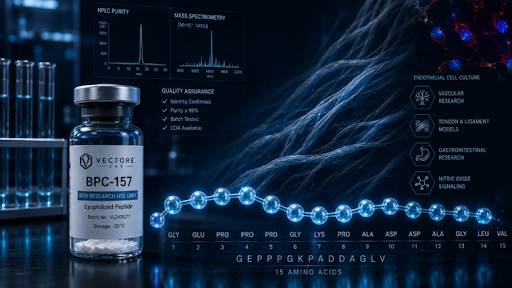
BPC-157 is among the most discussed peptides in regenerative studies. Its complete name is Body Protection Compound-157. BPC-157 is a synthetic peptide composed of 15 amino acids with the sequence GEPPPGKPADDAGLV.
BPC-157 was initially researched due to its association with gastric protection. Tissue-repair models pertaining to tendons, muscles, blood vessels, nerves, and the gastrointestinal system were later added to the investigations (Sikiric et al., 1992; Józwiak et al., 2025).
BPC-157 is typically regarded as a peptide in the research phase that has significant preclinical attention. However, it has not received FDA approval for treating injuries, gastrointestinal issues, pain, or any illness.
What Is BPC-157?
BPC-157 is a linear polypeptide that is compact. There are fifteen amino acids in it. According to PubChem, the molecular formula is C62H98N16O22, with an approximate molecular weight of 1419.5 g/mol (National Center for Biotechnology Information [NCBI], 2026).
Researchers are interested in BPC-157 because of its claimed stability in acidic environments. Numerous peptides decompose rapidly in stomach-like environments. BPC-157 has demonstrated remarkable stability in laboratory gastric environments (Sikiric et al., 2024).
This does not demonstrate that BPC-157 is effective in humans. It just explains why it's still interesting for preclinical and laboratory research.
Why Researchers Study BPC-157?
BPC-157 is primarily researched for its potential involvement in tissue protection and healing processes. Most of the findings come from animal and cell culture research.
Areas of study encompass:
tendon and ligament frameworks,
models of muscle injury,
protection of the gastrointestinal tract,
blood vessel repair,
nitric oxide communication,
wound-healing investigation.
These are research topics rather than approved medicinal uses.
How BPC-157 May Work?
There isn't a single confirmed human receptor target for BPC-157. Recent studies indicate various potential routes.
Blood Vessel Support: Tissue repair requires circulation. Blood vessels supply oxygen and nutrients to injured regions. According to preclinical research, BPC-157 may have an impact on vascular repair and angiogenesis (Sikiric et al., 2024).
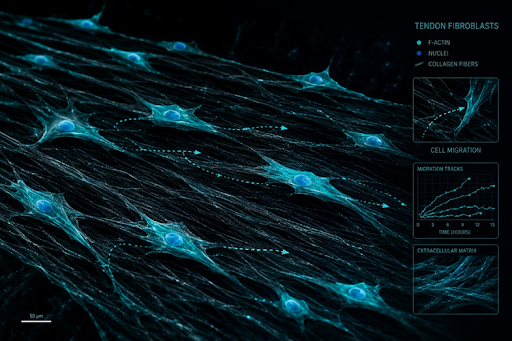
Tendon and Fibroblast Activity: A study on tendon cells revealed that BPC-157 enhanced the outgrowth, survival, and migration of tendon fibroblasts. In tendon-repair models, these pathways are essential (Chang et al., 2011).
Nitric Oxide Signaling: Nitric oxide aids in controlling blood circulation and the tone of blood vessels. Studies suggest that BPC-157 may affect nitric oxide-related pathways, such as endothelial cell activity (Sikiric et al., 2014).
Gut-Linked Protection: BPC-157 has been researched in models of gut-related injuries. Certain researchers indicate a potential gut–organ or gut–brain link, although this is still under investigation (Sikiric et al., 2016).
Form and Quality Testing
In research settings, BPC-157 is usually supplied as a white to off-white freeze-dried powder. Freeze-drying is referred to as lyophilization. This aids in minimizing water-related degradation and enhances storage stability.
Testing is essential for a peptide company that prioritizes quality. A reliable research peptide needs to be supported by:
HPLC or UHPLC analysis for purity assessment,
mass spectrometry verification of identity,
batch-specific COA,
clear lot number,
appropriate storage instructions.
Purity and identity are different concepts. Purity indicates the cleanliness of the sample. The identity confirms that the peptide is, in fact, BPC-157.
Route of Administration in Research
BPC-157 has been investigated through various methods in animal models, such as oral, subcutaneous, intramuscular, intravenous, and intraperitoneal delivery (Sikiric et al., 2024).
This does not mean that the public is permitted to utilize these routes. Human data is still prohibited. A registered Phase 2 clinical trial is studying BPC-157 for the repair of acute hamstring muscle strains, but results should not be presumed until they are published or officially released (ClinicalTrials.gov, 2026).
The key takeaway for consumers is that interest in research does not imply medical approval.
Safety and Regulatory Status
The FDA has not approved BPC-157 for any use in medicine. The FDA has categorized compounded drugs with BPC-157 as substances that could pose important safety hazards. Concerns include limited human safety data, possible immunogenicity, peptide-related contaminants, and manufacturing quality issues (Food and Drug Administration [FDA], 2026).
This is the reason why responsible companies should refrain from making claims like:
repairs wounds,
fixes tendons,
addresses digestive disorders,
relieves discomfort,
accelerates healing.
Instead of being classified as an approved treatment, BPC-157 should be described as a research peptide.
Regulation in sports is important as well. BPC-157 is listed as a prohibited substance by the World Anti-Doping Agency (World Anti-Doping Agency, 2026).
Why Quality Matters?
The peptide market has grown quickly. This growth has resulted in a serious issue: not all products sold online undergo adequate testing.
Quality control is crucial for research users. One should not rely solely on a product's label claiming “high purity.” Analytical testing that confirms identity and purity should be part of a suitable batch.
Prioritizing quality means focusing on:
verified peptide identity,
clean analytical testing,
batch-specific documentation,
responsible research communication,
no unsupported medical claims.
Future Outlook
BPC-157 continues to be a significant subject in the study of regenerative peptides. The main areas of interest are tendon models, gastrointestinal protection, tissue-repair biology, and vascular signaling.
The subsequent step is improved human data. Scientists still require more robust pharmacokinetic information, dose-response analyses, long-term safety evidence, independent validation, and regulated clinical results.
Until then, BPC-157 continues to be an investigational peptide of significance in preclinical models of tissue response, gastrointestinal functions, and vascular signaling.
Frequently Asked Questions
1. What is BPC-157? BPC-157 is a synthetic 15-amino-acid peptide primarily researched in laboratory and animal studies related to gastrointestinal, vascular, tendon, and tissue-response biology.
2. What is BPC-157 being researched for? Studies have investigated BPC-157 in models of tendon, ligament, gastrointestinal, vascular, nitric oxide, and injury response. These fields of research must not be interpreted as approved medical uses.
3. Is BPC-157 FDA approved? No. BPC-157 is not approved by the FDA for the treatment of injuries, pain, digestive issues, or other health conditions.
4. Does research prove that BPC-157 heals injuries? No. The majority of supporting evidence is derived from studies conducted on animals and in laboratories. Preclinical results cannot confirm healing, recovery, safety, or clinical efficacy in humans.
5. How is research-grade BPC-157 quality evaluated? Researchers might investigate peptide identity, chromatographic purity, mass spectrometry verification, batch records, lot traceability, water content, and additional relevant analytical factors.
References
Chang, C.-H., Tsai, W.-C., Lin, M.-S., Hsu, Y.-H., & Pang, J.-H. S. (2011). The promoting effect of pentadecapeptide BPC 157 on tendon healing involves tendon outgrowth, cell survival, and cell migration. Journal of Applied Physiology, 110(3), 774–780. https://doi.org/10.1152/japplphysiol.00945.2010
ClinicalTrials.gov. (2026). BPC-157 for acute hamstring muscle strain repair (ClinicalTrials.gov Identifier NCT07437547). U.S. National Library of Medicine. Retrieved June 29, 2026, from https://clinicaltrials.gov/study/NCT07437547
Food and Drug Administration. (2026). Certain bulk drug substances for use in compounding that may present significant safety risks. U.S. Department of Health and Human Services. Retrieved June 29, 2026, from https://www.fda.gov/drugs/human-drug-compounding/certain-bulk-drug-substances-use-compounding-may-present-significant-safety-risks
Józwiak, M., Bauer, M., Kamysz, W., & Kleczkowska, P. (2025). Multifunctionality and possible medical application of the BPC 157 peptide—Literature and patent review. Pharmaceuticals, 18(2), Article 185. https://doi.org/10.3390/ph18020185
National Center for Biotechnology Information. (n.d.). PubChem compound summary for BPC-157 (CID 9941957). PubChem. Retrieved June 29, 2026, from https://pubchem.ncbi.nlm.nih.gov/compound/9941957
Sikiric, P., Petek, M., Rucman, R., Seiwerth, S., Grabarevic, Z., Rotkvic, I., Turkovic, B., Jagic, V., Mildner, B., & Duvnjak, M. (1992). The significance of the gastroprotective effect of body protection compound (BPC): Modulation by different procedures. Acta Physiologica Hungarica, 80(1–4), 89–98.
Sikiric, P., Seiwerth, S., Rucman, R., Kolenc, D., Vuletic, L. B., Drmic, D., Grgic, T., Strbe, S., Zukanovic, G., Crvenkovic, D., Madzarac, G., Rukavina, I., Sucic, M., Baric, M., Starcevic, N., Krstanovic, Z., Rasic, Z., Marusic, M., & Boban-Blagaic, A. (2014). Stable gastric pentadecapeptide BPC 157-NO-system relation. Current Pharmaceutical Design, 20(7), 1126–1135. https://doi.org/10.2174/13816128113190990411
Sikiric, P., Seiwerth, S., Rucman, R., Kolenc, D., Vuletic, L. B., Drmic, D., Grgic, T., Strbe, S., Zukanovic, G., & Roguljic, H. (2016). Brain-gut axis and pentadecapeptide BPC 157: Theoretical and practical implications. Current Neuropharmacology, 14(8), 857–865. https://doi.org/10.2174/1570159X13666160502153022
Sikiric, P., Sever, M., Krezic, I., Vranes, H., Kalogjera, L., Smoday, I. M., Vukovic, V., Oroz, K., Zubcic, S., & Sikiric, S. (2024). New studies with stable gastric pentadecapeptide protecting gastrointestinal tract, significance of counteraction of vascular and multiorgan failure of occlusion/occlusion-like syndrome in cytoprotection/organoprotection. Inflammopharmacology, 32, 3119–3161. https://doi.org/10.1007/s10787-024-01566-0
World Anti-Doping Agency. (2026). The 2026 prohibited list: International standard. https://www.wada-ama.org/sites/default/files/2025-09/2026list_en_final_clean_september_2025.pdf