

Peptide Science
GHK-Cu: A Research Overview of Copper-Peptide Biology and Analytical Considerations
Introduction
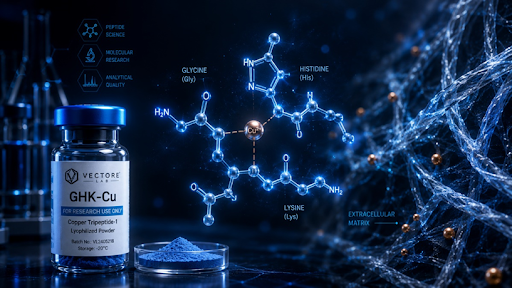
One of the most well-known copper peptides in the field of skin science is GHK-Cu. Another name for it is copper tripeptide-1. A copper ion and a small peptide known as GHK combine to make this molecule. The GHK-Cu name comes from the fact that it is made up of glycine, histidine and lysine.
The GHK-Cu is frequently discussed in relation to regeneration aesthetics, wound healing studies, skincare, and scalp products. The reason it is so popular is because it may help support the signals that tell our bodies to repair tissues. This does not mean it is an approved drug. It just means it is a complex that is really interesting to researchers who study cosmetic science and skin biology.
From a research perspective, GHK-Cu is most appropriately discussed in relation to cosmetic research, peptide formulation, extracellular matrix function, and models of wound healing. Present communication must refrain from therapeutic claims concerning disease treatment, wound healing, hair loss, or tissue damage unless these claims are backed by regulatory authorization.
What Is GHK-Cu?
The GHK is a tripeptide, which means it is made up of three acids: glycine, histidine and lysine. When the GHK binds to copper it forms the GHK-Cu.
Researchers have found GHK in plasma, saliva and urine. They have also found that the levels of GHK in our bodies decrease as we get older which has led to a lot of interest in its role in skin aging and tissue maintenance biology (Pickart et al., 2015).
Cosmetics do not employ copper as a mineral. It plays a role in many bodily functions, including the formation of collagen, antioxidant defense, connective tissue structure and blood vessel biology. GHK-Cu is being researched because it might aid in the controlled and peptide-bound delivery of copper to human bodies (Pickart & Margolina, 2018).
Structure of the Peptide
In comparison to proteins and antibodies, GHK-Cu is a tiny molecule. It has a base peptide that is made up of three amino acids. Because it facilitates the GHK-Cu's binding to copper, the histidine portion of the peptide is very significant.
This copper-binding element distinguishes GHK-Cu from numerous typical signal peptides. The peptide is more than a short sequence of amino acids. This is a peptide-metal complex. This framework influences stability, color, biological function, and formulation characteristics.
GHK-Cu, has an estimated molar mass of 401.9 g/mol and is generally expressed as C₄₄H₂₂CuN6O₄ (SpecialChem, 2024). However, because copper peptide complexes can be represented in various protonation, ionization, or coordination states, chemical databases may display slightly different formulas, such as C₁₄H₂₄CuN₆O₄ with a molecular weight of 403.92 g/mol (National Center for Biotechnology Information [NCBI], 2024).
Identity is important for product exploration. On a Certificate of Analysis, GHK and GHK-Cu cannot be considered the same. GHK is a peptide. GHK-Cu is the form complexed with copper. When appropriate, a quality program must confirm the peptide's identity as well as the status of the copper complex.
Physical and Chemical Properties
GHK-Cu is typically encountered as a blue or blue-green powder or liquid, varying with its concentration and formulation. Copper coordination may be indicated by color; however, color is not the only indicator of quality.
Main quality elements consist of:
peptide identity,
purity profile,
copper complex consistency,
heavy metal control,
residual solvents,
water content,
batch-specific documentation,
microbial quality when relevant.
There is not a single pH that works for all GHK-Cu products. The pH varies based on factors such as the buffer system, concentration, salt form, excipients, and the intended administration route. In topical formulation, pH must also consider skin compatibility and the stability of peptides.
For peptides intended for research, purity must be evaluated using HPLC or UHPLC methods. To confirm identity, mass spectrometry should be employed. These tests help separate label assertions from true analytical evidence.
How GHK-Cu May Work?
GHK-Cu seems to operate through multiple pathways rather than just one. It is examined as a multifunctional peptide complex.
Collagen and Extracellular Matrix Support: The extracellular matrix serves as the framework surrounding skin cells. It includes collagen, elastin, glycosaminoglycans, and various other structural elements. The effects of GHK-Cu on matrix remodeling, collagen-associated pathways, and fibroblast function have been investigated (Pickart et al., 2015; Mortazavi et al., 2024). For a consumer, this means that research on skin quality, texture, and obvious indications of aging focuses mostly on GHK-Cu. It must not be referred to as a cure or a tissue-regeneration therapy.
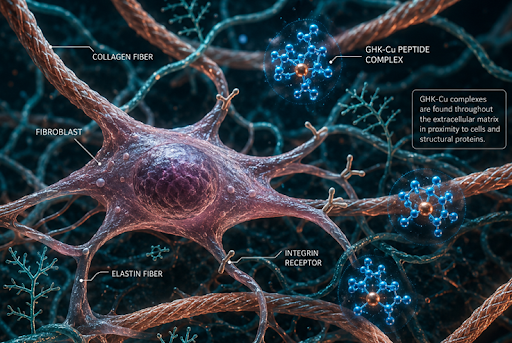
Copper Transport: Copper helps enzymes that work on connective tissue and keep us safe from harm. GHK-Cu helps carry copper in a way that our bodies can use it. This is one reason it is examined differently from fundamental moisturizing components (Pickart & Margolina, 2018).
Inflammation Balance: Inflammation is a component of standard healing. Excessive inflammation can hinder recovery and affect how well tissues repair. Some studies suggest that GHK-Cu and similar tripeptides has been investigated in experimental models involving inflammatory signaling and tissue-remodeling pathways (Adnan et al., 2025).
Gene Expression and Tissue Remodeling: The impact of GHK-Cu on gene expression associated with cellular maintenance, matrix reconfiguration, antioxidant defense, and repair has been investigated (Pickart & Margolina, 2018). These results are of scientific interest. They ought to be shown as research results, not clinical evidence.
Formulation and Delivery Strategies
GHK-Cu faces a challenge that many peptides do. The molecule might be biologically significant, but its delivery governs practical effectiveness. Safety, skin contact, controlled release, and localized exposure are the main focuses of current formulation efforts.
Liposomal Systems: Liposomes are fat-like particles. They might assist in safeguarding GHK-Cu and enhance its interaction with the skin barrier. This method is beneficial in topical peptide formulation where stability and penetration are important (Mortazavi et al., 2024).
Nanoparticle-Based Carriers: Nanoparticle carriers are being investigated as protective systems for bioactive peptides. This should be described as an evolving formulation method for GHK-Cu. Although it is not a recognized clinical delivery method, it may help protect the peptide and support controlled release.
Hydrogel Dressings: Hydrogels are soft materials that are abundant in water. They can directly inject bioactive chemicals while preserving the moisture content of a wound model. Recent studies incorporated GHK-Cu into a self-repairing hydrogel system for models of infected wound healing (Chen et al., 2025).
Biomaterial Scaffolds: In tissue-engineering research, biomaterial scaffolds are used as three-dimensional support structures. GHK-Cu can be integrated into these systems to examine cellular growth, matrix remodeling, and blood vessel formation. This remains a research-level science and has not been approved for use in medicine (Adnan et al., 2025).
Route of Administration
Topical application is the most prevalent and significant usage of GHK-Cu in skincare and cosmetic research. This encompasses serums, creams, lotions, scalp treatments, and beauty products.
Many peptides cannot be administered orally because digestive enzymes can break them down before substantial absorption occurs.
Injectable GHK-Cu is distinct. It involves heightened regulatory and safety issues. Due to possible immunogenicity, aggregation, peptide-related impurities, and inadequate human safety data, the FDA has identified compounded injectable GHK-Cu as a safety concern (Food and Drug Administration [FDA], 2026a).
A clinical study registered is assessing topical GHK-Cu gel for healing acute skin wounds. This does not suggest that GHK-Cu has been approved as a medication for wound healing, but it does show an ongoing research interest (ClinicalTrials.gov, 2026).
Regulatory Position
The FDA monitors cosmetics in the US, however aside from color additives, the majority of cosmetic goods and ingredients do not need FDA approval before being marketed. Companies remain accountable for safety, labeling, and accurate claims (FDA, 2025).
The categorization is defined by the claim. Products that improve the appearance of skin are usually sold as cosmetics. A product that claims it can heal wounds, address hair loss, regenerate tissue, or cure illnesses may be classified as a drug.
GHK-Cu is classified as a Category 1 material for compounding review in the FDA's 2026 update, with the exception of injectable delivery routes. This has not received FDA approval. This indicates that the substance is currently being evaluated for compounding policy (FDA, 2026b).
Future Outlook
GHK-Cu continues to hold significance in the field of topical peptide research. Its most promising immediate future lies in cosmetic formulation, scalp-care studies, wound-healing processes, hydrogel delivery methods, and biomaterial systems.
Improved human data is the next phase. More accurate dose-response studies, better topical administration data, long-term safety evaluations, and improved clinical outcomes are all needed by researchers.
Currently, GHK-Cu should be regarded as a copper-binding peptide that holds significant cosmetic and research importance. It cannot be presented as a recognized form of treatment.
Frequently Asked Questions
1. What is GHK-Cu peptide? GHK-Cu is a copper-binding complex created from the tripeptide glycine-histidine-lysine along with copper. It is frequently examined in research on skin biology, formulation, and extracellular matrix.
2. Is GHK-Cu the same as GHK? No. GHK is the peptide alone, whereas GHK-Cu denotes its form complexed with copper. This differentiation may be significant for molecular identification and analytical records.
3. Why are researchers interested in GHK-Cu? Research has investigated GHK-Cu concerning copper-dependent mechanisms, fibroblast functions, extracellular-matrix signaling, gene regulation, and skin-model biology.
4. Is GHK-Cu proven to reverse skin aging or regrow hair? The evidence does not support the claim that research-grade GHK-Cu is an established treatment for anti-aging, hair growth, wound healing, or tissue regeneration.
5. How can GHK-Cu quality be evaluated? Relevant factors can encompass peptide identity, chromatographic purity, copper-complex characterization, residual solvents, moisture levels, heavy-metal management, and documentation specific to each batch.
References
Adnan, S. B., Maarof, M., Fauzi, M. B., & Fadilah, N. I. M. (2025). Exploring the role of tripeptides in wound healing and skin regeneration: A comprehensive review. International Journal of Medical Sciences, 22(16), 4175–4200. https://doi.org/10.7150/ijms.118118
Chen, H., Yang, P., Xue, P., Li, S., Dan, X., Li, Y., Lei, L., & Fan, X. (2025). Food-derived tripeptide–copper self-healing hydrogel for infected wound healing. Biomaterials Research, 29, Article 0139. https://doi.org/10.34133/bmr.0139
ClinicalTrials.gov. (2026). Topical GHK-Cu gel for acute skin wound healing (CuHeal) (ClinicalTrials.gov Identifier NCT07437586). U.S. National Library of Medicine. Retrieved June 29, 2026, from https://clinicaltrials.gov/study/NCT07437586
Mortazavi, S. M., Mohammadi Vadoud, S. A., & Moghimi, H. R. (2024). Topically applied GHK as an anti-wrinkle peptide: Advantages, problems and prospective. BioImpacts, 15, Article 30071. https://doi.org/10.34172/bi.30071
National Center for Biotechnology Information. (2024). PubChem compound summary for Cu-GHK (CID 378611). PubChem. https://pubchem.ncbi.nlm.nih.gov/compound/Cu-GHK
Pickart, L., Vasquez-Soltero, J. M., & Margolina, A. (2015). GHK peptide as a natural modulator of multiple cellular pathways in skin regeneration. BioMed Research International, 2015, Article 648108. https://doi.org/10.1155/2015/648108
Pickart, L., & Margolina, A. (2018). Regenerative and protective actions of the GHK-Cu peptide in the light of the new gene data. International Journal of Molecular Sciences, 19(7), Article 1987. https://doi.org/10.3390/ijms19071987
SpecialChem. (2024, April 24). Copper Tripeptide-1. https://www.specialchem.com/cosmetics/inci-ingredients/copper-tripeptide-1
U.S. Food and Drug Administration. (2025, November 18). FDA authority over cosmetics: How cosmetics are not FDA-approved, but are FDA-regulated. https://www.fda.gov/cosmetics/cosmetics-laws-regulations/fda-authority-over-cosmetics-how-cosmetics-are-not-fda-approved-are-fda-regulated
U.S. Food and Drug Administration. (2026). Certain bulk drug substances for use in compounding that may present significant safety risks. https://www.fda.gov/drugs/human-drug-compounding/certain-bulk-drug-substances-use-compounding-may-present-significant-safety-risks
U.S. Food and Drug Administration. (2026, May 14). Bulk drug substances nominated for use in compounding under section 503A of the Federal Food, Drug, and Cosmetic Act. https://www.fda.gov/media/94155/download