

Peptide Science
Ipamorelin: Investigating the Science of Selective GH Secretagogue Studies
Introduction
Ipamorelin is a synthetic pentapeptide that has been investigated in growth hormone secretagogue studies. It is frequently categorized alongside peptides that affect the growth hormone axis, yet it is neither growth hormone nor an analog of growth hormone-releasing hormone. The receptor-driven activation of endogenous growth hormone release via growth hormone secretagogue routes gives it research relevance.
Ipamorelin should be considered as a research peptide. The FDA has not approved its usage for the treatment of hormone deficiencies, aging, weight loss, muscle enhancement, recovery, or general well-being. A precise scientific discussion must center on molecular identity, receptor function, GH-axis signaling, analytical integrity, evidence limitations, and regulatory constraints.
What Is Ipamorelin?
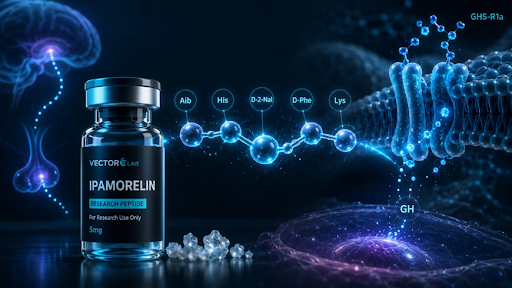
A synthetic pentapeptide called ipamorelin was developed while researching growth hormone secretagogues. The initial pharmacology study recognized Ipamorelin as Aib-His-D-2-Nal-D-Phe-Lys-NH2 and described its growth hormone-releasing effects both in vitro and in vivo (Raun et al., 1998). According to PubChem, ipamorelin has the chemical formula C38H49N9O5, a molecular weight of 711.9 g/mol, and the CAS number 170851-70-4 (National Center for Biotechnology Information, n.d.).
Aib Residue: Ipamorelin features Aib, also known as alpha-aminoisobutyric acid, at its N-terminal position. Aib is an atypical amino acid that can improve structural stability and restrict peptide flexibility. In peptide design, structures that include Aib are frequently employed to affect peptide conformation and enhance resistance to enzymatic degradation (Toniolo et al., 2001).
D-2-Nal Residue: D-2-Nal, also referred to as D-2-naphthylalanine, is an aromatic non-standard amino acid found in ipamorelin. This residue plays a role in the peptide’s receptor-binding characteristics and is included in the sequence that identifies Ipamorelin as a specific growth hormone secretagogue (Raun et al., 1998).
Due to the presence of non-standard residues in Ipamorelin, it is crucial to perform identity testing. HPLC/UHPLC evaluates purity, while mass spectrometry helps confirm the expected molecular weight and identification of changed peptides (National Center for Biotechnology Information, n.d.).
Why Researchers Study Ipamorelin?
Researchers investigate Ipamorelin as it is part of the group of growth hormone secretagogues. Usually through the ghrelin/growth hormone secretagogue receptor pathway, growth hormone secretagogues stimulate GH secretion (Smith, 2005; Ishida et al., 2020).
Ipamorelin has received research attention because preliminary research revealed a focused release of growth hormone without the cortisol or ACTH effects associated with other earlier GHRP compounds. Raun et al. (1998) observed GH release in animal models and pointed out that ACTH and cortisol levels did not considerably rise at doses far higher than those required for GH release.
How Ipamorelin May Work?
Ipamorelin is researched as a ligand for the ghrelin receptor pathway. Growth hormone is not directly supplied by it. Instead, its receptor-associated effects on endogenous GH release have been investigated.
GHS-R Pathway Activation: The ghrelin receptor, referred to as GHS-R1a, participates in the release of growth hormone, appetite regulation, energy homeostasis, and neuroendocrine control. Ghrelin influences the release of growth hormone through pituitary and hypothalamus pathways (Young & Goyal, 2023). The GH-releasing effect of Ipamorelin was found to be inhibited by GHRP antagonism, indicating a GHRP/GHS-like mechanism (Raun et al., 1998).
Growth Hormone Release: The release of growth hormone typically occurs in pulses and is controlled by feedback mechanisms that include the hypothalamus, pituitary gland, liver, and peripheral tissues. Ipamorelin is being investigated as a precursor to GH replacement because, rather than directly replacing growth hormone, it influences the pituitary GH production (Raun et al., 1998).
IGF-1 Signaling: Growth hormone may increase the production of insulin-like growth factor-1 in the liver and peripheral tissues. IGF-1 serves as a downstream mediator for the effects of GH in growth, metabolism, and tissue signaling. Ipamorelin investigations may therefore monitor GH and IGF-1 simultaneously. Changes in these biomarkers should not be regarded as evidence of clinical advantage without regulated human data.

Research Areas and Evidence Limits
The most compelling mechanistic evidence for Ipamorelin arises from preclinical and early pharmacological studies demonstrating GH release and receptor-associated activity (Raun et al., 1998). Additionally, it has been studied in gastric motility models. In a model of postoperative ileus in rodents, Ipamorelin enhanced gastric motility issues via mechanisms involving ghrelin receptors (Greenwood-Van Meerveld et al., 2012).
Although postoperative ileus was also studied in clinical trials, this does not validate ipamorelin as a recommended treatment. The FDA has reported significant adverse events, including fatalities, in studies using intravenous Ipamorelin for gastric motility and pointed out a lack of adequate safety data for other injectable administration routes (U.S. Food and Drug Administration, 2026).
Ipamorelin regularly appears in studies pertaining to body composition and aging since GH and IGF-1 are important for metabolism, lean mass, and tissue maintenance. This needs to be articulated thoughtfully. Presently, the available evidence does not endorse the use of research-grade Ipamorelin as an authorized product for anti-aging, fat loss, recovery, or performance enhancement.
Form and Quality Testing
For use in lab research, ipamorelin is usually sold as a freeze-dried powder. Quality testing is essential due to the peptide's non-standard amino acid characteristics. The FDA has made it clear that ipamorelin acetate contains artificial amino acids, which makes characterization more difficult (U.S. Food and Drug Administration, 2026).
Verification of peptide identity
HPLC or UHPLC analysis for purity assessment
Confirmation of mass spectrometry
Certificate of Analysis Specific to Batch
Control of residual solvents
Water-content data when applicable
Testing for endotoxins or microbes when necessary
Transparent storage and handling guidelines.
Identity and purity are two different ideas. The sample's cleanliness is indicated by its purity. Identity confirms that the peptide is indeed ipamorelin.
Storage and Handling
Peptides may be affected by heat, humidity, repeated freezing and thawing, and contamination. Ipamorelin must be kept in controlled research environments and in accordance with supplier recommendations.
Protect lyophilized material from humidity.
Prevent frequent temperature fluctuations.
Utilize a suitable diluent according to the protocol.
Record the lot number and the date of reconstitution.
Avoid unsupported route or dosing claims
Verify storage requirements on the COA.
Before being used in any controlled experiment, the ultimate research solution must be checked for clarity, particulate matter, and unusual discoloration.
Regulatory Position
The FDA has not authorized ipamorelin for widespread clinical usage. Because of issues like immunogenicity, aggregation, peptide-related impurities, unresolved route-related safety concerns, and complex characterization, the FDA classifies compounded medications containing ipamorelin acetate as potential safety risks for particular administration routes (U.S. Food and Drug Administration, 2026).
This regulatory position does not diminish its research significance. This means that communication needs to be exact. Rather than being a medicinal or consumer wellness product, ipamorelin should be regarded as a research peptide having importance in endocrine and receptor signaling.
Final Takeaway
The main use of ipamorelin is as a selective synthetic growth hormone secretagogue in GH-axis research. Its significance arises from examining receptor pathways, models of growth hormone release, and studies of endocrine signaling.
Discussing high-quality research should emphasize molecular identity, receptor mechanisms, analytical validation, limits of evidence, and regulatory standing. Interest in research is not the same as approval. That is an important distinction for a comprehensive peptide guide.
Frequently Asked Questions
1. What is Ipamorelin? Ipamorelin is a synthetic pentapeptide researched as a secretagogue for growth hormone. Its research focuses on receptor-mediated signaling of the GH axis instead of direct growth hormone replacement.
2. How does Ipamorelin work in research? Ipamorelin has been studied via the ghrelin/growth-hormone secretagogue receptor pathway, examining its impact on endogenous GH release in experimental settings.
3. Is Ipamorelin FDA approved? No. Ipamorelin lacks FDA approval for anti-aging, weight loss, muscle growth, recovery, hormone replacement, or overall wellness.
4. Is Ipamorelin the same as growth hormone? No. Ipamorelin is not a growth hormone. It is examined as a receptor ligand that could affect endogenous growth-hormone signaling.
5. Why is analytical testing important for Ipamorelin? Ipamorelin includes atypical amino-acid residues, making precise molecular identification essential. HPLC/UHPLC alongside mass spectrometry can offer complementary quality information.
References
Greenwood-Van Meerveld, B., Kriegsman, M., Nelson, R., Palmer, J. M., & Nagahisa, A. (2012). Efficacy of ipamorelin, a ghrelin mimetic, on gastric dysmotility in a rodent model of postoperative ileus. Journal of Pharmacology and Experimental Therapeutics, 342(3), 769–776. https://doi.org/10.1124/jpet.112.194910
Ishida, J., Saitoh, M., Ebner, N., Anker, S. D., Springer, J., & von Haehling, S. (2020). Growth hormone secretagogues: History, mechanism of action, and clinical development. JCSM Rapid Communications, 3, 25–37. https://doi.org/10.1002/rco2.9
National Center for Biotechnology Information. (n.d.). PubChem compound summary for Ipamorelin (CID 9831659). PubChem. Retrieved July 14, 2026, from https://pubchem.ncbi.nlm.nih.gov/compound/Ipamorelin
Raun, K., Hansen, B. S., Johansen, N. L., Thogersen, H., Madsen, K., Ankersen, M., & Andersen, P. H. (1998). Ipamorelin, the first selective growth hormone secretagogue. European Journal of Endocrinology, 139(5), 552–561. https://doi.org/10.1530/eje.0.1390552
Smith, R. G. (2005). Development of growth hormone secretagogues. Endocrine Reviews, 26(3), 346–360. https://doi.org/10.1210/er.2004-0019
Toniolo, C., Crisma, M., Formaggio, F., & Peggion, C. (2001). Control of peptide conformation by the Thorpe–Ingold effect: Cα-tetrasubstitution. Biopolymers, 60(6), 396–419. https://doi.org/10.1002/1097-0282(2001)60:6%3C396::AID-BIP10183%3E3.0.CO;2-J
U.S. Food and Drug Administration. (2026). Certain bulk drug substances for use in compounding that may present significant safety risks. https://www.fda.gov/drugs/human-drug-compounding/certain-bulk-drug-substances-use-compounding-may-present-significant-safety-risks
Young, E. R., & Goyal, A. (2023). Biochemistry, ghrelin. In StatPearls. StatPearls Publishing. https://www.ncbi.nlm.nih.gov/books/NBK547692/