

Research
Purity Standards: Why 99% HPLC Doesn't Tell the Whole Story of Quality
Introduction
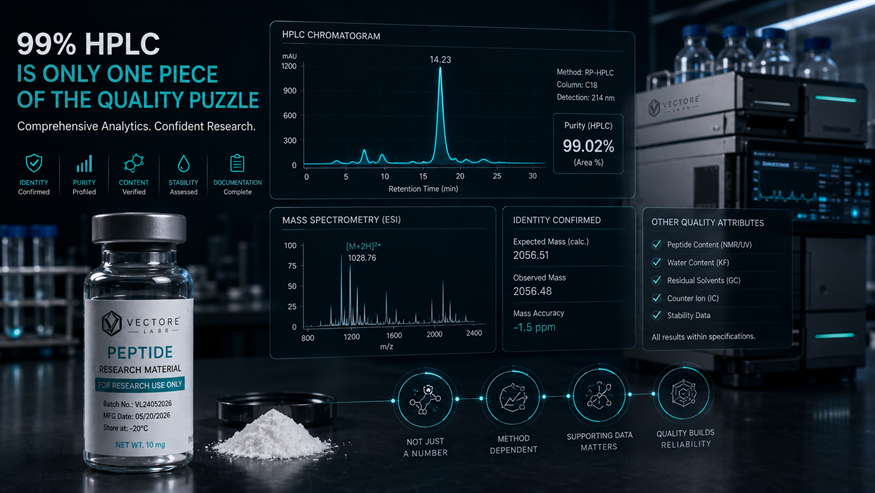
A stated value like “99% HPLC purity” can be beneficial, but it does not fully represent peptide quality. Typically, the figure denotes the percentage of integrated ultraviolet peak area attributed to the main component using a specific chromatographic technique. It does not, on its own, determine the sequence of the peptide, total amount, counterion content, water content, remaining solvents, sterility, endotoxin level, or stability. A quality assessment suited for its purpose integrates validated chromatographic information with identity verification and other measurements chosen for the specific research application (U.S. Food and Drug Administration [FDA], 2021, 2024a, 2024b).
The relevant quality attributes are determined by the material and design of the study. For a synthetic peptide, the relevant panel could encompass identity, chromatographic purity, impurity profile, peptide content or assay, counterion, residual water, residual solvents, appearance, and stability. Testing for microbiological or endotoxins may also be appropriate when those characteristics could influence the experiment. A certificate of analysis must present actual batch results compared to defined acceptance standards instead of depending solely on a purity assertion (FDA, 2016, 2021).
From Sequence to Crude Peptide: Solid-Phase Peptide Synthesis
Solid-phase peptide synthesis (SPPS) was proposed by Merrifield as a sequential technique in which a developing peptide remains covalently bonded to an insoluble substrate. Filtration and washing can eliminate reagents and soluble by-products following each reaction. Contemporary SPPS typically employs Fmoc/tBu or Boc/Bzl protection methods, automated processes, and resin-linker systems chosen based on the necessary C-terminal functionality (Merrifield, 1963; Muttenthaler et al., 2021).
A standard Fmoc-based procedure involves the subsequent steps:
Resin and linker choice: The initial protected amino acid is coupled to, or provided preloaded on, a resin via a linker selected for the intended C-terminal acid, amide, or alternative functionality.
Fmoc removal: A base, typically piperidine in dimethylformamide, eliminates the protective N-terminal Fmoc group. Boc chemistry employs an acid-sensitive protection method and must not be referred to as utilizing identical deprotection conditions.
Activation and coupling: The subsequent protected amino acid is activated using an appropriate coupling system and interacts with the unbound amine on the resin-attached chain. The selection of reagents and their excess relies on the sequence, scale, and associated process risks.
Cleaning and monitoring cycles: Continuous washing eliminates soluble reagents and by-products. Monitoring the completion of coupling or deprotection can help minimize deletion sequences and other impurities related to the process.
Final cleavage and side-chain deprotection: In Fmoc/tBu SPPS, a cleavage mixture based on TFA along with suitable scavengers is typically utilized. Boc/Bzl chemistry might need distinct cleavage conditions. The obtained material is a raw peptide and still needs purification and characterization.
Purification and Analytical HPLC
Crude peptide includes the target sequence along with components related to processing and degradation. These may involve deletion sequences, shortened chains, incompletely deprotected species, oxidized products, diastereomers, reagent-derived addition compounds, and leftover cleavage materials. Preparative reversed-phase HPLC is commonly applied to extract the primary component, whereas analytical HPLC or UHPLC is utilized to assess the resulting impurity profile (Mant et al., 2007).
In reversed-phase chromatography, peptide constituents are distinguished by varying interactions with a nonpolar phase and a relatively polar mobile phase. C18 and C8 bonded phases are widely used, yet the ideal column chemistry, gradient, pH, temperature, ion-pairing agents, flow rate, and detection wavelength vary based on the peptide and the analytical objective. Peptide bonds are typically observed around 210–220 nm, while aromatic residues can also be detected at longer wavelengths (Mant et al., 2007).
A "99%" outcome typically signifies that the main peak represents roughly 99% of the total integrated detector response according to the specified method. It does not inherently equal 99% peptide by mass. Co-elution, variations in detector response, integration parameters, sample preparation, column selectivity, wavelength, and weak or non-responsive impurities can alter the perceived value. The approach must be specific, appropriate for its intended use, and verified or qualified with adequate attention to accuracy, precision, specificity, range, detection ability, and strength (FDA, 2024a, 2024b).

Counterions: TFA, Acetate, and Other Salt Forms
Trifluoroacetic acid (TFA) is commonly utilized in Fmoc/tBu peptide cleavage and serves as an ion-pairing agent in reversed-phase purification. Consequently, basic peptides can be obtained as TFA salts, with the quantity of linked counterion affected by sequence, charge, purification, exchange method, and drying conditions. The counterion affects the overall mass of the sample and can impact solubility, pH, aggregation, membrane interactions, and certain biological assay outcomes (Erckes et al., 2025; Little et al., 2007).
Exchanging counterions to acetate, chloride, or an alternative form may be suitable for a specific application, yet no salt form ensures universal compatibility or biological safety. Exchange may also affect yield, solubility, physical structure, and stability. The scientifically valid method involves identifying and measuring the counterion, specifying the salt form on the COA and specification, and assessing its impact on the intended assay instead of presuming that acetate is always safe or that any detectable TFA disqualifies the material (Erckes et al., 2025).
Identity Testing by Mass Spectrometry
Mass spectrometry assesses ions based on their mass-to-charge ratio. Electrospray ionization and matrix-assisted laser desorption/ionization are widely utilized for peptides, and the deconvolution of various charge states can yield an observed molecular mass. A strong correlation with the theoretical mass indicates that the primary component possesses the anticipated molecular composition (FDA, 2021).
An intact-mass match does not constitute complete sequence evidence, however. Isomeric residues, certain sequence rearrangements, stereochemical variations, and co-eluting species might not be distinguished through a straightforward mass measurement. Based on the risk and objective, further characterization might involve LC–MS/MS, peptide mapping, amino acid analysis, high-resolution MS, spectroscopic techniques, or comparison with a validated reference standard. HPLC and MS complement each other: chromatography assesses separation and relative impurity levels, while MS aids in confirming molecular identity.
Peptide Composition Differs from Chromatographic Purity
Chromatographic purity indicates the allocation of identified components; peptide content or assay estimates the quantity of peptide within the measured substance. A sample might exhibit a 99% primary peak but still include significant water, counterion, inorganic salts, or other non-UV-absorbing substances. In quantitative experiments, utilizing the gross vial weight as though it contained entirely peptide could result in concentration error.
In scenarios where concentration precision is crucial, the COA must differentiate HPLC area purity from peptide content or analysis. Purposeful methods may consist of amino acid analysis, quantitative nuclear magnetic resonance, a validated assay compared to a reference standard, or another supported quantitative technique. The method and calculation foundation must be explicitly outlined, specifying if the result is reported on an anhydrous, counterion-free, or as-is basis (FDA, 2021, 2024b).
Lyophilization and Formulation
Lyophilization may enhance the storage properties of certain peptide formulations by eliminating water in a controlled environment. The procedure involves freezing, primary drying—where ice sublimates under lower pressure—and secondary drying, which eliminates more tightly bound water. During cycle development, factors such as product temperature, chamber pressure, formulation composition, fill volume, container closure, and the critical temperature of the frozen matrix need to be taken into account (Tang & Pikal, 2004).
Freeze-drying does not inherently produce a stable or highly soluble item. Peptides remain susceptible to oxidation, deamidation, aggregation, adsorption, or moisture-related degradation, and an excessively dry or inadequately formulated cake might rehydrate slowly. Targets for residual moisture and cycle temperatures should be defined for the particular peptide and formulation, rather than using generalized values (Nugrahadi et al., 2023; Tang & Pikal, 2004).
Atmosphere Control and Packaging
Inert dry gas can be utilized during certain manufacturing or packaging processes to minimize contact with oxygen and moisture. This can benefit oxidation-sensitive or hygroscopic materials; however, nitrogen flushing is not an all-encompassing necessity and cannot substitute for an appropriate container-closure system, moisture barrier, or stability program. The advantage must be evidenced for the particular formulation and procedure (Nugrahadi et al., 2023).
Storage and Shipping Conditions
The storage needs for peptides are determined by the specific product. A general guideline to keep all lyophilized peptides at −20 °C or −80 °C lacks scientific justification unless stability data is provided. Degradation is influenced by sequence, formulation, water content, oxygen exposure, light, container closure, and storage duration. Proper transport conditions, retest intervals, and specified storage temperatures must be backed by a documented stability program and included in the product documentation (FDA, 2003, 2016).
Researchers must adhere to the batch documentation and a validated lab protocol. Brief temperature fluctuations do not inevitably lead to failure, and freezing shipments does not ensure preservation. When excursion limits are crucial, they need to be established based on real-time or expedited stability data instead of being presumed.
Certificate of Analysis: What It Should Establish
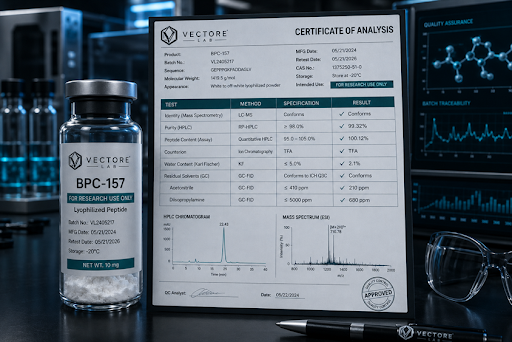
A certificate of analysis is a quality document specific to a batch. In accordance with ICH Q7 principles, a scientifically informative COA should specify the material and grade, batch or lot number, release date, conducted tests, acceptance criteria, numerical results, and the approved quality unit. It must also recognize the actual manufacturer or the lab accountable for the analysis, if relevant (FDA, 2016).
For a synthetic research peptide, an informative COA might encompass the following elements when applicable to the specification:
Identity: Observed molecular weight and the identification technique employed.
Chromatographic purity and impurity characterization: Technique, wavelength, column or method identifier, main-peak results, and observed impurities.
Peptide concentration or measurement: A separate quantitative outcome when precise concentration is necessary.
Counterion: Salt variant and quantified measurement or validated specification.
Moisture level: Karl Fischer, drying loss, or an alternative appropriate technique, if applicable.
Residual solvents: Results or limits for process solvents when relevant.
Physical form and appearance: For instance, powder or freeze-dried cake, without considering appearance as verification of identity.
Microbiological characteristics: Bioburden, endotoxin, or sterility are assessed only when necessary for the intended use and validated by appropriate methods.
Storage and expiration: Recorded storage conditions along with an expiration or retesting date backed by stability data.
Endotoxin testing cannot replace sterility testing, and the requirement for either characteristic relies on the product and its intended use. When endotoxin is identified, the technique must be appropriate for the substance and manage product-related interference (FDA, 2026).
A COA's reliability depends on the sampling, method appropriateness, data integrity, traceability, and quality assessment that support it. The existence of a document marked “COA” alone does not necessarily demonstrate that the batch satisfies a scientifically suitable specification.
Interpreting the Data
No individual analytical result defines every quality characteristic. Orthogonal evidence is used in the most reliable analysis: an appropriate chromatographic technique for profiling purity and impurities, mass spectrometry or an alternative method for identity verification, an independent quantitative assay when peptide levels are important, and focused assessments for counterion, water, residual solvents, stability, and microbiological features when necessary. This method provides more insight than considering “99% HPLC” as a global quality benchmark.
Frequently Asked Questions
1. Does 99% HPLC mean a peptide is 99% pure by weight? Not obligatory. A 99% HPLC result generally indicates the relative area of the chromatographic peak under a certain method and does not directly correspond to 99% peptide content by weight.
2. Is HPLC enough to confirm peptide quality? No. HPLC mainly offers information on chromatographic purity. Verification of identity, analysis of peptide composition, evaluation of counterions, determination of water content, and various other tests might also be relevant.
3. What is the difference between peptide purity and peptide identity? Purity indicates the ratio of identified components in a sample, whereas identity verifies if the substance matches the expected peptide molecule.
4. Why is mass spectrometry used for peptide testing? Mass spectrometry provides information related to molecular mass and can aid in verifying that the main component aligns with the expected peptide molecular entity.
5. What should a peptide Certificate of Analysis include? A beneficial batch-specific COA might encompass identity, chromatographic purity, peptide content when relevant, counterion information, water or residual solvents, lot information, and relevant stability parameters.
References
Erckes, V., Streuli, A., Chamera Rendueles, L., Krämer, S. D., & Steuer, C. (2025). Towards a consensus for the analysis and exchange of TFA as a counterion in synthetic peptides and its influence on membrane permeation. Pharmaceuticals, 18(8), 1163. https://doi.org/10.3390/ph18081163
Little, M. J., Aubry, N., Beaudoin, M.-E., Goudreau, N., & LaPlante, S. R. (2007). Quantifying trifluoroacetic acid as a counterion in drug discovery by 19F NMR and capillary electrophoresis. Journal of Pharmaceutical and Biomedical Analysis, 43(4), 1324–1330. https://doi.org/10.1016/j.jpba.2006.10.039
Mant, C. T., Chen, Y., Yan, Z., Popa, T. V., Kovacs, J. M., Mills, J. B., Tripet, B. P., & Hodges, R. S. (2007). HPLC analysis and purification of peptides. In G. B. Fields (Ed.), Peptide characterization and application protocols (Methods in Molecular Biology, Vol. 386, pp. 3–55). Humana Press. https://doi.org/10.1007/978-1-59745-430-8_1
Merrifield, R. B. (1963). Solid phase peptide synthesis. I. The synthesis of a tetrapeptide. Journal of the American Chemical Society, 85(14), 2149–2154. https://doi.org/10.1021/ja00897a025
Muttenthaler, M., King, G. F., Adams, D. J., & Alewood, P. F. (2021). Trends in peptide drug discovery. Nature Reviews Drug Discovery, 20(4), 309–325. https://doi.org/10.1038/s41573-020-00135-8
Nugrahadi, P. P., Hinrichs, W. L. J., Frijlink, H. W., Schöneich, C., & Avanti, C. (2023). Designing formulation strategies for enhanced stability of therapeutic peptides in aqueous solutions: A review. Pharmaceutics, 15(3), 935. https://doi.org/10.3390/pharmaceutics15030935
Tang, X., & Pikal, M. J. (2004). Design of freeze-drying processes for pharmaceuticals: Practical advice. Pharmaceutical Research, 21(2), 191–200. https://doi.org/10.1023/B:PHAM.0000016234.73023.75
U.S. Food and Drug Administration. (2003, November). Q1A(R2) stability testing of new drug substances and products: Guidance for industry. https://www.fda.gov/regulatory-information/search-fda-guidance-documents/q1ar2-stability-testing-new-drug-substances-and-products
U.S. Food and Drug Administration. (2016, September). Q7 good manufacturing practice guidance for active pharmaceutical ingredients: Guidance for industry. https://www.fda.gov/regulatory-information/search-fda-guidance-documents/q7-good-manufacturing-practice-guidance-active-pharmaceutical-ingredients-guidance-industry
U.S. Food and Drug Administration. (2021, May). ANDAs for certain highly purified synthetic peptide drug products that refer to listed drugs of rDNA origin: Guidance for industry. https://www.fda.gov/regulatory-information/search-fda-guidance-documents/andas-certain-highly-purified-synthetic-peptide-drug-products-refer-listed-drugs-rdna-origin
U.S. Food and Drug Administration. (2024a, March). Q14 analytical procedure development: Guidance for industry. https://www.fda.gov/regulatory-information/search-fda-guidance-documents/q14-analytical-procedure-development
U.S. Food and Drug Administration. (2024b, March). Q2(R2) validation of analytical procedures: Guidance for industry. https://www.fda.gov/regulatory-information/search-fda-guidance-documents/q2r2-validation-analytical-procedures
U.S. Food and Drug Administration. (2026, March). Pyrogen and endotoxins testing: Questions and answers—Guidance for industry. https://www.fda.gov/regulatory-information/search-fda-guidance-documents/pyrogen-and-endotoxins-testing-questions-and-answers