

Research
The Precision Revolution: Why Peptides Represent the Future of Contemporary Medicine
Introduction
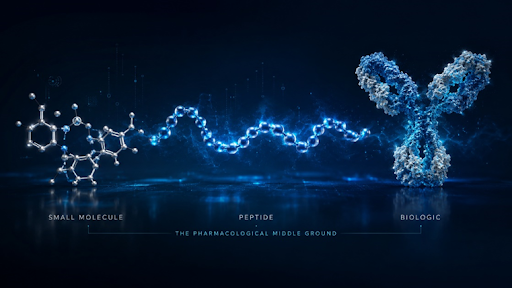
Peptide therapies now hold a significant position between conventional small-molecule medications and large biological agents. Typically, they are brief amino acid sequences that possess sufficient structural complexity to selectively engage with biological targets, yet remain chemically alterable for enhancements in stability, delivery, and half-life (Muttenthaler et al., 2021; Wang et al., 2022).
The opportunity is evident, but the obligation is also apparent. On the internet, approved peptide drugs, experimental candidates, compounded products, and materials intended exclusively for research are often referenced together. These classifications should stay distinct. An effective educational resource must clarify peptide science without suggesting that all research peptides are safe, authorized, or suitable for clinical application.
The "Goldilocks" of Drug Design
Peptides reside within a beneficial pharmacological range. They are bigger and more organized than numerous small molecules, yet smaller than antibodies and the majority of protein biologics. This provides them with a practical equilibrium of target interaction, chemical adaptability, and biological significance (Fosgerau & Hoffmann, 2015; Muttenthaler et al., 2021).
Numerous therapeutic peptides are created from natural hormones, signaling fragments, antimicrobial peptides, or modified analogs. The sequence can be altered via lipidation, cyclization, PEGylation, substitution of amino acids, or terminal protection to enhance stability and pharmacokinetic characteristics (Wang et al., 2022).
Target Precision: Why Peptides Can Be Selective
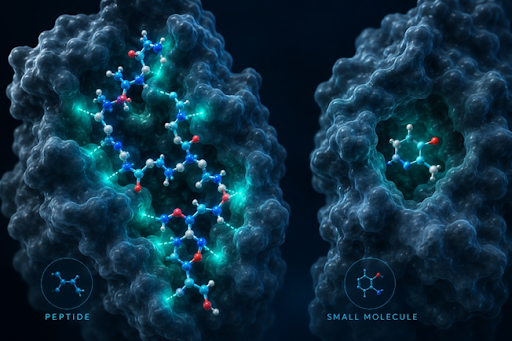
Peptides can establish multiple interaction sites with a receptor or enzyme. This can enhance binding selectivity in contrast to small molecules that might depend on smaller binding sites. This is a reason why peptides are significant in research related to endocrine, metabolic, oncology, immune, and receptor signaling (Muttenthaler et al., 2021; Wang et al., 2022).
Accuracy does not imply being without risk. Target selectivity relies on sequence, receptor allocation, dosage, administration method, formulation, and patient circumstances. Consequently, peptide pharmaceutical products necessitate thorough assessment of pharmacokinetics, liver function, drug interactions, QTc risk, and immunogenicity when applicable (U.S. Food and Drug Administration, 2023).
Communicating in the Body’s Native Language
The human body functions as a machine driven by peptides. Peptide-like compounds are inherently utilized by humans as growth factors, hormones, and neurotransmitters. Consequently, approved peptide therapeutics show that peptide-oriented molecular designs can yield clinically significant pharmacological effects in particular indications.
One example of this method is GLP-1 receptor agonists. Semaglutide is a modified version of GLP-1 intended to stimulate the GLP-1 receptor and has been thoroughly assessed in controlled clinical trials. The STEP 1 Phase 3 trial evaluated semaglutide in adults with overweight or obesity and documented variations in body weight outcomes in comparison to placebo as per a specified clinical protocol that incorporated lifestyle changes (Wilding et al., 2021).
These results pertain to the drug formulation, dosage, study group, and clinical circumstances examined in that trial. They should not to be extended to research-grade semaglutide materials or viewed as proof of similar clinical results outside the investigated context.
Receptor Interaction and Molecular Selectivity
Certain peptide therapies demonstrate strong receptor affinity or functional efficacy, influenced by their sequence, structure, and target molecule. Recent progress in peptide engineering has facilitated the creation of multi-receptor agonists aimed at influencing multiple signaling pathways. The pharmacological characteristics of these compounds are determined by receptor interaction, relative strength, specificity, and the particular experimental or clinical setting.
Retatrutide is an experimental triple agonist that targets the glucagon, GIP, and GLP-1 receptors. Clinical trials have assessed this multi-receptor pharmacology concerning metabolic and body-weight outcomes in specific study groups (Jastreboff et al., 2023). These results pertain to regulated clinical studies and should not be viewed as confirming therapeutic efficacy for research-quality retatrutide substances.
Safety and Regulation Status:
Peptides consist of amino acids, and numerous degrade into biologically recognizable segments. This may enhance tolerability for certain peptide medications. However, it is incorrect to claim that peptides are inherently safer than small molecules or biologics. Safety relies on the specific molecule, contaminants, dosage, administration method, immune response, pharmacological properties, and the clinical group.
The FDA’s guidance on clinical pharmacology for peptide drug products emphasizes the importance of addressing immunogenicity, liver impairment, drug-drug interactions, QTc prolongation risk, pharmacokinetics, safety, and efficacy in the development process (U.S. Food and Drug Administration, 2023).
Quality: Identity, Purity, and Contamination Management
The assertion of “99% pure” does not validate peptide quality. A reliable peptide product must include identity testing, purity evaluation, assessment of peptide-related impurities, analysis of residual solvents if applicable, relevant water-content information, and stability data.
The FDA guidance regarding highly purified synthetic peptide drug products highlights that synthetic peptides might have impurities resulting from synthesis, degradation, or storage, and that impurity profiles are included in the quality assessment (U.S. Food and Drug Administration, 2021). Purity data from HPLC or UHPLC, along with identity confirmation through mass spectrometry, is crucial for research-centric communication.
Chemically Alterable: Engineered for Durability
Earlier peptide medications frequently faced restrictions due to rapid enzymatic breakdown and brief half-life. Contemporary peptide development employs various tools to enhance stability and optimize delivery. Typical techniques encompass cyclization, stapling, lipidation, PEGylation, amino acid replacement, terminal shielding, nanocarrier systems, and stabilization through lyophilization (Wang et al., 2022).
These changes can enhance performance, but they must not be regarded as evidence of clinical advantage. Each change needs to be backed by analytical data, stability studies, pharmacological information, and safety assessments.
Regulatory Limits and the RUO Issue
A major risk in the peptide market is confusion between categories. A molecule can be examined in studies, utilized in clinical trials, authorized in a particular final drug formulation, or marketed online using research-use terminology. They are not identical.
The FDA has issued a warning regarding unapproved GLP-1 products sold to consumers, including products misleadingly labeled as “for research purposes” or “not for human consumption” (U.S. Food and Drug Administration, 2026). This alert is particularly significant for peptide firms as it illustrates the importance of proper labeling, managing claims, and staying informed about regulations.
Summary
Peptides are essential due to their integration of biological signaling, selective targeting, and flexibility in chemical design. They have transformed metabolic medicine with GLP-1 receptor agonists and are further advancing into oncology, endocrinology, rare diseases, drug delivery, and precision therapeutics.
Peptide investigation is most revealing when the molecular identity, analytical quality, experimental proof, and regulatory status are well recorded and analyzed within the limits of the available data. In peptide therapy, trust is established through evidence, not exaggeration.
Frequently Asked Questions
What are peptides and why are they important in modern research? Peptides consist of short chains of amino acids capable of engaging with biological targets. Their composition can also be altered chemically, rendering them valuable resources in receptor, signaling, and drug-design studies.
How are peptides different from small-molecule drugs? Peptides tend to be bigger and more structurally intricate than typical small molecules. This may enable several interactions with biological targets, yet behavior varies based on the individual molecule.
Are peptides more selective than small molecules? Certain peptides can exhibit significant target selectivity due to forming numerous molecular interactions. Selectivity varies and relies on sequence, structure, receptors, and experimental conditions.
How can scientists make peptides more stable? Research methods encompass lipidation, cyclization, amino acid replacement, PEGylation, terminal modifications, formulation techniques, and lyophilization. Their efficacy needs to be assessed for the particular peptide.
References
Fosgerau, K., & Hoffmann, T. (2015). Peptide therapeutics: Current status and future directions. Drug Discovery Today, 20(1), 122–128. https://doi.org/10.1016/j.drudis.2014.10.003
Jastreboff, A. M., Kaplan, L. M., Frías, J. P., Wu, Q., Du, Y., Gurbuz, S., Coskun, T., Haupt, A., Milicevic, Z., & Hartman, M. L. (2023). Triple–hormone-receptor agonist retatrutide for obesity—A phase 2 trial. The New England Journal of Medicine, 389(6), 514–526. https://doi.org/10.1056/NEJMoa2301972
Muttenthaler, M., King, G. F., Adams, D. J., & Alewood, P. F. (2021). Trends in peptide drug discovery. Nature Reviews Drug Discovery, 20, 309–325. https://doi.org/10.1038/s41573-020-00135-8
U.S. Food and Drug Administration. (2021). ANDAs for certain highly purified synthetic peptide drug products that refer to listed drugs of rDNA origin: Guidance for industry. https://www.fda.gov/regulatory-information/search-fda-guidance-documents/andas-certain-highly-purified-synthetic-peptide-drug-products-refer-listed-drugs-rdna-origin
U.S. Food and Drug Administration. (2023). Clinical pharmacology considerations for peptide drug products: Guidance for industry. https://www.fda.gov/regulatory-information/search-fda-guidance-documents/clinical-pharmacology-considerations-peptide-drug-products
U.S. Food and Drug Administration. (2026). FDA’s concerns with unapproved GLP-1 drugs used for weight loss. https://www.fda.gov/drugs/drug-alerts-and-statements/fdas-concerns-unapproved-glp-1-drugs-used-weight-loss
Wang, L., Wang, N., Zhang, W., Cheng, X., Yan, Z., Shao, G., Wang, X., Wang, R., & Fu, C. (2022). Therapeutic peptides: Current applications and future directions. Signal Transduction and Targeted Therapy, 7, Article 48. https://doi.org/10.1038/s41392-022-00904-4
Wilding, J. P. H., Batterham, R. L., Calanna, S., Davies, M., Van Gaal, L. F., Lingvay, I., McGowan, B. M., Rosenstock, J., Tran, M. T. D., Wadden, T. A., Wharton, S., Yokote, K., Zeuthen, N., & Kushner, R. F. (2021). Once-weekly semaglutide in adults with overweight or obesity. The New England Journal of Medicine, 384(11), 989–1002. https://doi.org/10.1056/NEJMoa2032183