
Peptide Science
Wolverine Stack: A Research-Focused Review of BPC-157 and TB-500
Introduction
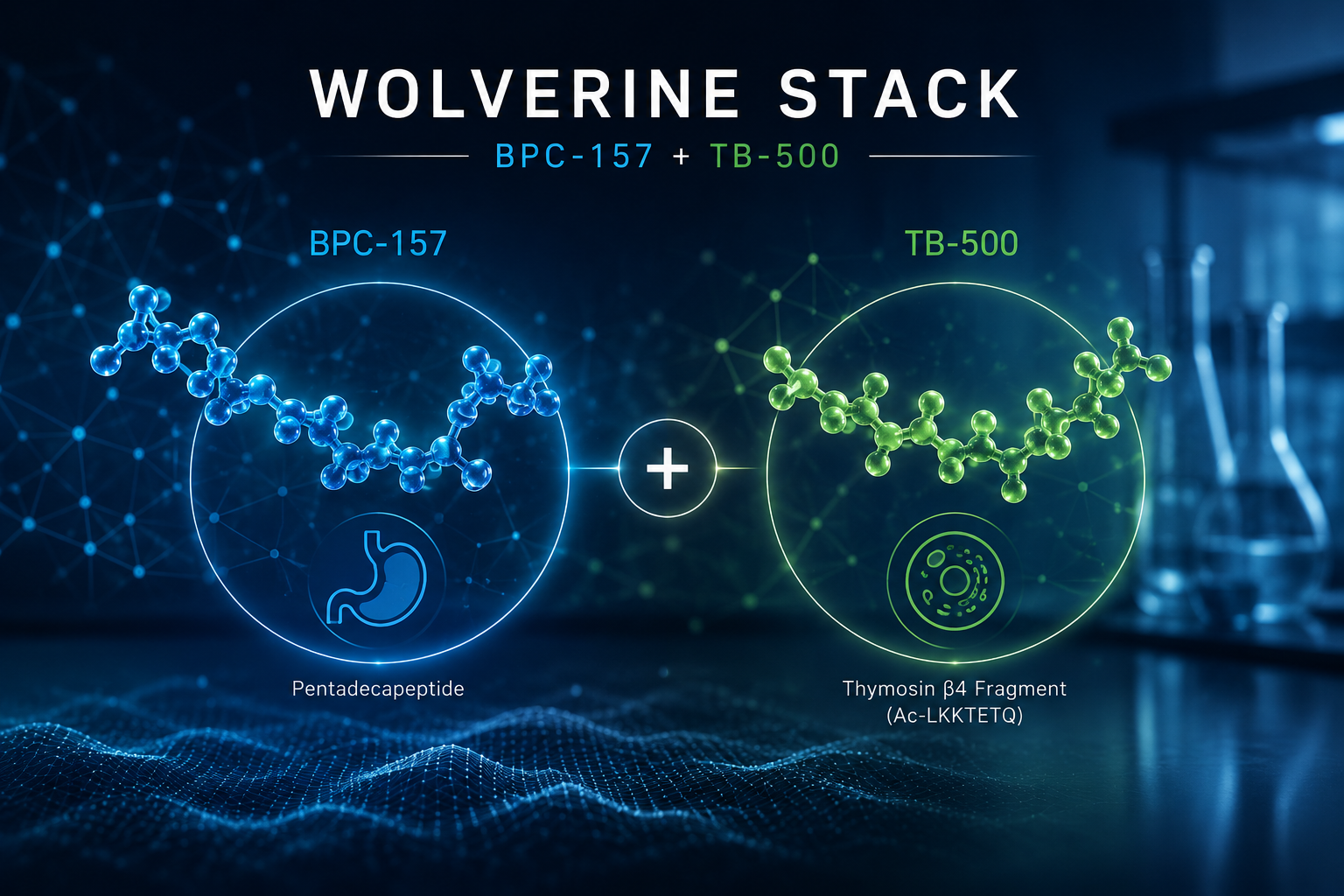
The combination of BPC-157 and TB-500 is referred to as "Wolverine Stack" in an informal manner. It is not a clinically proven therapeutic approach, an FDA-approved combination, or an established pharmaceutical treatment.
The evidence base requires an important distinction: much of the often-cited repair literature relates to full-length thymosin β4 (Tβ4), not the short peptide identified in commercial TB-500 products, while BPC-157 has mainly been researched in preclinical models. TB-500 is an N-terminally acetylated fragment of thymosin β4, specifically the 17–23 sequence, Ac-LKKTETQ, according to analytical tests (Esposito et al., 2012). Consequently, results from full-length Tβ4 should not be indiscriminately assigned to TB-500.
The Wolverine Stack is therefore best viewed as an investigational research concept based on distinct peptide systems, rather than an established synergistic combination.
Proposed Research Rationale
The proposed rationale for combining BPC-157 with TB-500-related compounds is based on different experimental investigations of cell migration, cytoskeletal regulation, vascular responses, and tissue-repair mechanisms. Currently, there is inadequate direct evidence showing additive or synergistic effects from a standardized combination of BPC-157 and TB-500.
BPC-157 and Fibroblast/Tendon Models
In preclinical and in vitro studies, BPC-157 is associated with tendon fibroblast proliferation, increased cell survival under experimental stress, and fibroblast migration (Chang et al., 2011). Following experimental exposure to BPC-157, rat models for ligaments and tendons have demonstrated differences in histological, biomechanical, or functional outcomes (Cerovecki et al., 2010; Staresinic et al., 2003). The efficacy of human therapy is not supported by these findings.
Thymosin β4 and Cytoskeletal Biology
Full-length thymosin β4 is an actin-binding peptide investigated in the biology of cell migration, angiogenesis, and wound healing. Research involving animals has indicated alterations in re-epithelialization, wound contraction, and the healing of ligaments following the experimental administration of thymosin β4 (Malinda et al., 1999; Xu et al., 2013). These findings should be considered contextual biology rather than direct evidence for TB-500, since TB-500 is a particular fragment associated with thymosin β4 rather than the full-length Tβ4.
Vascular and Inflammatory Signaling
Research on both BPC-157 and thymosin β4 has encompassed vascular and angiogenesis-related pathways. The development and alteration of vascular structures are important to numerous experimental injury models since vascular signals can affect oxygen transport, cell movement, and tissue arrangement. In controlled human studies, the extent to which these mechanisms relevant to a BPC-157/TB-500 combination is still unknown.
Inflammatory Signaling
Research studies focusing on BPC-157 and thymosin β4 systems have examined pathways related to inflammatory responses. Inflammation is a complex feature of injury biology and differs based on tissue, experimental model, timing, and molecular factors. Therefore, rather than claiming that these peptides reduce inflammation or have anti-inflammatory benefits, it is more correct to state that they have been studied in models related to inflammation-associated signaling.
Is There Evidence of Synergy?
Synergy requires evidence that the combined impact of two substances exceeds the expected outcomes of their individual effects in appropriately regulated conditions. This requires uniform component identity, defined concentrations, suitable controls, confirmed endpoints, and reproducible combination experiments. Research on BPC-157 and peptides associated with thymosin β4 separately makes up the majority of the available evidence. Controlled research demonstrating that a particular BPC-157/TB-500 combination produces additive or synergistic effects is lacking.
Human Evidence Remains Limited
Human evidence presents a significant limitation. The majority of BPC-157 research is comprised of studies conducted in laboratories and on animals. A well-defined clinical safety or efficacy profile cannot be defined with the limited and insufficient human data currently available. There is even less evidence for a defined BPC-157/TB-500 combination.
The FDA currently indicates that compounded products with BPC-157 could pose issues regarding immunogenicity, impurities related to peptides, and the characterization of active pharmaceutical ingredients, noting that the agency has limited safety data for suggested human exposure routes (U.S. Food and Drug Administration, 2026). The FDA notes that it has not identified data concerning human exposure for compounded products containing the thymosin β4 fragment (LKKTETQ), which it refers to as TB-500. The agency also concerns potential problems with immunogenicity and peptide impurities (U.S. Food and Drug Administration, 2026). These regulatory results emphasize how crucial it is to separate established clinical uses from research interests.
Analytical Quality Matters
In laboratory research, every component must be characterized separately. A quality package centered on research might consist of:
Identity: Validate the predicted molecular species using LC-MS or another complementary mass-based method.
Chromatographic purity: Evaluation of the main peak and associated impurities using RP-HPLC or UPLC.
Peptide content: The HPLC area percentage and a quantitative assay need to be distinguished.
Counterion and water levels: These can influence mass balance and calculations of experimental concentration.
Lot traceability: The analytical records must correspond to the specific batch used.
Component definition: The documentation must differentiate between BPC-157, full-length thymosin β4, and the particular TB-500-related fragment or material that is present.
Regulatory and Research Context
BPC-157 and TB-500 are not FDA-approved medications for tissue repair. FDA has recognized possible safety issues with compounded BPC-157, such as immunogenicity and difficulties related to peptide impurities and API characterization. The FDA emphasizes the lack of human exposure evidence for compounded products containing the thymosin β4 fragment (LKKTETQ), also known as TB-500, and highlights potential concerns about immunogenicity and contaminants associated with this fragment (U.S. Food and Drug Administration, n.d.).
Research in competitive sports also requires regulatory awareness. Now in effect, the 2026 World Anti-Doping Agency's Prohibited List classifies compounds related to thymosin β4 and BPC-157 within frameworks that are relevant to athletes and anti-doping research (World Anti-Doping Agency, 2026).
Future Research Priorities
Crucial evidence gaps comprise standardized definitions of materials, validated combination research, pharmacokinetic profiling, dose-response investigations, long-term safety information, and regulated human trials. Research communication must differentiate mechanistic results from clinical claims and should refrain from assuming that comprehensive thymosin β4 data confirm the effects of TB-500.
From a research perspective, it is best to avoid making claims about faster healing, tissue regeneration, recovery, or therapeutic benefits and instead concentrate on molecular identity, analytical characterization, model-specific outcomes, evidence limitations, and regulatory context.
Frequently Asked Questions
1. What is the Wolverine Stack? "Wolverine Stack" is a casual term for a research combination that includes BPC-157 and TB-500-associated compounds. This combination is neither FDA-approved nor clinically established.
2. Why are BPC-157 and TB-500 discussed together? The combination is based on the hypothesis that separate peptide systems could affect shared pathways related to cell migration, cytoskeletal dynamics, vascular activity, and tissue responses.
3. Is the Wolverine Stack proven to accelerate healing? No. There is a lack of direct clinical evidence that demonstrates accelerated healing, regeneration, recovery, or therapeutic synergy for the BPC-157/TB-500 combination.
4. Is TB-500 the same as thymosin beta-4? No, TB-500 is recognized as a fragment related to thymosin β4, so findings derived from full-length thymosin β4 shouldn't be automatically assigned to TB-500.
5. What should researchers verify in a Wolverine Stack blend? Every component must be assessed separately for identity, chromatographic purity, peptide quantity, counterion/water condition, molecular specification, and lot-specific records.
References
Cerovecki, T., Bojanic, I., Brcic, L., Radic, B., Vukoja, I., Seiwerth, S., & Sikiric, P. (2010). Pentadecapeptide BPC 157 (PL 14736) improves ligament healing in the rat. Journal of Orthopaedic Research, 28(9), 1155–1161. https://doi.org/10.1002/jor.21107
Chang, C.-H., Tsai, W.-C., Lin, M.-S., Hsu, Y.-H., & Pang, J.-H. S. (2011). The promoting effect of pentadecapeptide BPC 157 on tendon healing involves tendon outgrowth, cell survival, and cell migration. Journal of Applied Physiology, 110(3), 774–780. https://doi.org/10.1152/japplphysiol.00945.2010
Esposito, S., Deventer, K., Goeman, J., Van der Eycken, J., & Van Eenoo, P. (2012). Synthesis and characterization of the N-terminal acetylated 17–23 fragment of thymosin beta 4 identified in TB-500, a product suspected to possess doping potential. Drug Testing and Analysis, 4(9), 733–738. https://doi.org/10.1002/dta.1402
Malinda, K. M., Sidhu, G. S., Mani, H., Banaudha, K., Maheshwari, R. K., Goldstein, A. L., & Kleinman, H. K. (1999). Thymosin beta4 accelerates wound healing. Journal of Investigative Dermatology, 113(3), 364–368. https://doi.org/10.1046/j.1523-1747.1999.00708.x
Staresinic, M., Sebecic, B., Patrlj, L., Jadrijevic, S., Suknaic, S., Perovic, D., Aralica, G., Zarkovic, N., Borovic, S., Srdjak, M., Hajdarevic, K., Kopljar, M., Batelja, L., Boban-Blagaic, A., Turcic, I., Anic, T., Seiwerth, S., & Sikiric, P. (2003). Gastric pentadecapeptide BPC 157 accelerates healing of transected rat Achilles tendon and in vitro stimulates tendocytes growth. Journal of Orthopaedic Research, 21(6), 976–983. https://doi.org/10.1016/S0736-0266(03)00110-4
U.S. Food and Drug Administration. (n.d.). Certain bulk drug substances for use in compounding that may present significant safety risks. Retrieved August 15, 2026.
World Anti-Doping Agency. (2026). The 2026 prohibited list.
Xu, B., Yang, M., Li, Z., Zhang, Y., Jiang, Z., Guan, S., & Jiang, D. (2013). Thymosin β4 enhances the healing of medial collateral ligament injury in rat. Regulatory Peptides, 184, 1–5. https://doi.org/10.1016/j.regpep.2013.03.026